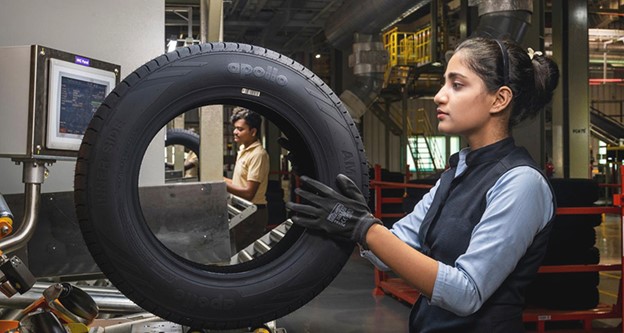
India operations post record revenue as tire maker runs at more than 90% capacity utilisation
Gurugram, India – Apollo Tyres reported a 12.8% year-on-year increase in consolidated revenue in the first quarter of fiscal 2026-27, supported by strong growth in its Indian operations.
For the three months ended 30 June, group revenue rose to INR74 billion (€670 million), from INR65.6 billion a year earlier, while operating profit was broadly unchanged at INR8.7 billion, Apollo reported 6 Aug.
The tire maker said its first-quarter performance was achieved despite “a challenging macroeconomic environment” and sharply higher raw material costs.
Indian operations
Indian operations generated record revenue of INR54.6 billion during the quarter, up 15.6% year-on-year and 4.3% sequentially, said outgoing finance chief Gaurav Kumar during an earnings call.
Kumar described the growth as “largely volume-led”, with Apollo recording double-digit volume growth across its three main channels. Replacement volumes increased 13% year-on-year, OEM volumes rose 10% and exports grew 15%.
The company also recorded double-digit growth across product categories, with the exception of truck and bus bias tires.
According to Kumar, Apollo's India business generated earnings (EBITDA) of INR6.5 billion during the quarter, down 12% compared with INR7.4 billion a year earlier.
The earnings decline was largely attributed to a sharp 17% increase in raw materials cost.
Despite this, Apollo said it “largely successfully defended margins through a combination of calibrated price increases and disciplined cost control”.
The strong Indian market is also driving Apollo's capacity expansion plans, with the company currently operating at utilisation levels “in the 90s.”
The utilisation rates in India, Kumar added, are expected to remain “very tight on capacity” throughout the 2027 fiscal year, which started 1 April.
Apollo is currently expanding passenger car tire capacity at its Andhra Pradesh plant by around 8,000 tires per day, in addition to its European project to add capacity for 4,000 tires per day in Hungary.
“I think the financial market had thought that some of our expansion plans are aggressive, but [with] the kind of demand that we've seen in India... if anything, we are a quarter late than early,” Kumar said.
European operations
In Europe, revenue increased 0.5% year-on-year to €147 million, with volumes growing by low single digits.
Apollo said the business continued to face the impact of the transition following the closure of its Enschede plant in the Netherlands.
“The PCR replacement segment continues to deliver healthy growth and the positive momentum is expected to sustain through the coming quarters,” Kumar said.
He added that PCR replacement growth in Europe was already in double digits and “well ahead of the market”.
However, the Enschede closure and transfer of truck radial capacity from Hungary to India resulted in some lost revenue during the transition.
“The reason why you see a muted top line growth is on account of agri tires where the transition resulted in a certain amount of revenue loss,” Kumar said.
“Similarly, with the shifting of the truck radial capacity from Hungary to India, and [although] the market in Europe and in India boomed, we had the capacity in transition and that resulted into certain revenue loss.”
Apollo expects European growth to improve as the transfers are completed.
The Enschede plant stopped production as planned in June, while production of some lower-end passenger car tires previously made in Hungary is being transferred to India.
Kumar said a large part of the roughly 750,000 tires produced at Enschede for sale in the previous year would shift to Hungary, while some lower-end 14- and 15-inch tire production from Hungary would move to India.
Commenting on the outlook, the finance chief said raw material inflation was expected to remain a pressure, with the group forecasting an additional 8% sequential increase in raw material costs in the second quarter.
“Commodity prices are likely to remain volatile until the geopolitical situation in West Asia [Middle East] stabilises,” Kumar said.