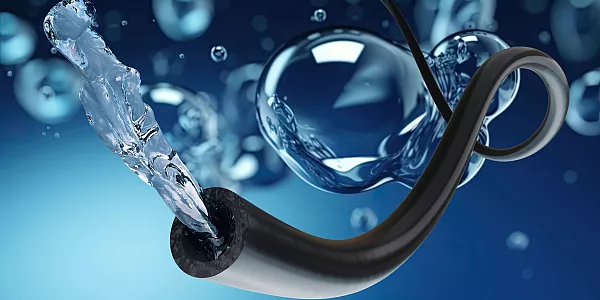
Frankfurt, Germany - Materials made from elastomers* that come into contact with drinking water are essential for a safe and health-safe supply to consumers, as is the sustainable use of these materials in high-quality, durable products within the drinking water supply and domestic plumbing systems.
Over the past few decades, both customer expectations and the requirements set by regulatory authorities for these materials have changed significantly.
Technical requirements for elastomers are defined according to their application by national, European or international standards, or by specifications set by other technical regulatory bodies.
The mechanical properties and service life of the materials and products are tested in accordance with these standards.
The quality and hygienic safety of drinking water are of the utmost importance. Substances that enter drinking water could be ingested by the body over the course of a lifetime.
It is, therefore, essential to keep these substances out of drinking water – as far as possible – and, as a precautionary measure, also to prevent the migration of substances for which no health risks are currently known. This applies to all materials, such as metals, glass, ceramics, plastics and elastomers.
Organic substances, in particular, can also promote the growth of bacteria and thus lead to the contamination of drinking water.
In Germany, the following laws and regulations apply to the hygienic assessment of elastomers: the Infection Protection Act, the Drinking Water Ordinance and the assessment criteria for materials and substances in contact with drinking water.
New legal framework
These will in future be superseded by the new EU legal framework for materials and substances in contact with drinking water, which will apply from 31 December 2026.
The European Drinking Water Directive of December 2020 on the quality of water intended for human consumption sets out, in Article 11, general minimum hygiene requirements for materials and substances that come into contact with water intended for human consumption.
This authorises the European Commission to adopt legal acts to specify these general minimum hygiene requirements in more detail. The six relevant legal acts were published in January 2024.
The legal act on product testing and conformity assessment sets out uniform minimum requirements for materials and substances in contact with drinking water. Furthermore, there is a certification requirement for products made from final materials and substances intended for contact with drinking water.
The EU certificates must be issued by conformity assessment bodies that are accredited and notified to the European Commission.
For a conformity assessment body headquartered in Germany, this means that, in addition to its accreditation by the German Accreditation Body (DAkkS), it must also be notified by the notifying authority (DE) to the European Commission and the other Member States.
Products certified in accordance with European requirements must be marked with a specified symbol and may be used in Germany for the construction and maintenance of water supply systems without the need for further certification regarding drinking water hygiene.
In the legal act governing the positive lists maintained by the European Chemicals Agency (ECHA), an expiry date is specified for each listed chemical. If a chemical is to be used beyond its expiry date, an application must be submitted to ECHA 12 months before the expiry date. The application procedure is described and set out in a separate legal act.
This procedure also applies to the notification of new chemicals. It sets out the methods and requirements for the evaluation of starting substances, formulations and constituents. When submitting an application, the applicant must provide a corresponding assessment, which is reviewed by ECHA’s Committee for Risk Assessment (RAC).
Outlook for elastomers
Following this overview of current and future regulations on drinking water contact materials made from elastomers and TPE, we will now provide an overview of the various activities in the field of elastomers and TPE.
Starting with the manufacture of products in accordance with the KTW elastomer guideline more than 30 years ago, regulatory requirements have become increasingly stringent and, partly due to expanding knowledge of the raw materials used, ever more comprehensive.
This led to the development of KTW assessment criteria for plastics, organic coatings and, ultimately, for elastomers and TPE as well. Only for silicone materials does a KTW recommendation still apply.
The transitional recommendation does not yet constitute an assessment basis within the meaning of the Drinking Water Regulation (TrinkwV). It is therefore not legally binding. It reflects the current state of science and technology with regard to drinking water hygiene requirements for silicones in contact with drinking water.
Furthermore, all European countries have their own specific regulations for materials intended to come into contact with drinking water. Consequently, there was a growing desire within the affected industry for rapid, uniform regulation, in line with the motto: ‘One rule, one assessment one certificate throughout Europe’.
To this end, discussions were held in the EU Member States and in Brussels at the European Commission with the aim of transforming the existing Drinking Water Directive into a Drinking Water Regulation. Unfortunately, this proved impossible because three Directorates-General are responsible for this legislation.
This led to the adoption of the Directive presented in December 2020. This Directive must be transposed into national law, although further tightening of the requirements is possible at that stage. In Germany, this took place in June 2023 in the form of the Drinking Water Regulation.
However, the aspiration of ‘one rule, one assessment, one certificate throughout Europe’ had still not been realised.
Now, instead of dealing with the 36-page elastomer guideline, one must grapple with European legal acts totalling 518 pages, which in turn are accompanied by several hundred pages of guidelines and specifications for applications, usage, etc., to explain and facilitate their implementation.
It has therefore already become a bureaucratic monster even before it comes into force on 31 December 2026. A further increase in requirements and explanatory notes is to be expected. The aspiration: ‘One rule, one assessment one certificate throughout Europe’ will therefore not materialise as envisaged.
Market distortion
Furthermore, there remains an unresolved problem: there is already a distortion of competition due to the disadvantage faced by European manufacturers, who have committed themselves wholeheartedly to implementing the requirements but are competing in the market against products that have not been tested in Europe.
There is currently no sign of effective market surveillance to counteract this. Illustrated using Germany as an example: The underlying laws are transposed from European legislation into federal laws; federal authorities then draw up, for example, the KTW assessment criteria on the basis of a mandate from the relevant federal ministries.
Market surveillance is the responsibility of the federal states; in this case, the district health authorities. This has already led to some market participants withdrawing from this market due to the significantly increased requirements.
Once the re-evaluations of the chemicals begin, it is certainly to be expected that the motivation of raw material suppliers to carry out a new substance evaluation will be limited.
This is because the effort involved in submitting a substance application is considerable, whilst sales volumes in this specialist market are low.
Furthermore, the chemicals required by the rubber industry are produced by a large number of manufacturers who, for competitive reasons, will not submit joint substance applications.
Consequently, in response to the question posed in the headline: ‘Well thought out – poorly executed?’, the conclusion must be: ‘Well thought out – but poorly executed.’
*Refers to cured elastomers and thermoplastic elastomers
ERJ image source: Kraiburg