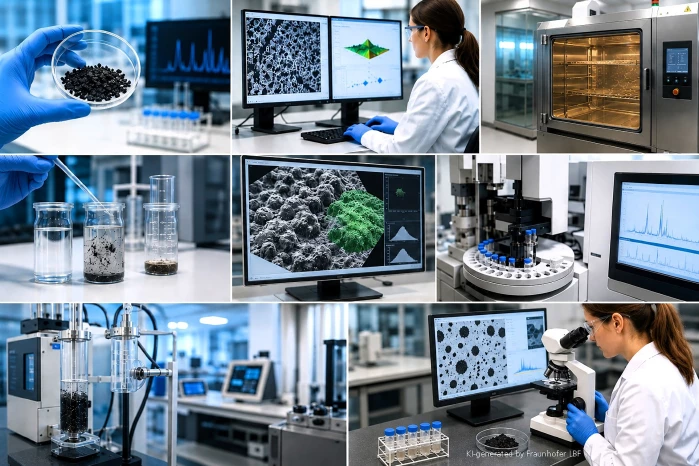
Project TERIS aims to standardise laboratory generation, analysis and prediction of tire wear
Darmstadt, Germany – Fraunhofer-led tire wear consortium TERIS* claims to have reached a "decisive milestone" in developing laboratory methods to ‘generate, analyse and predict’ tire wear in a "standardised and practical manner."
Headed by the Fraunhofer Institute for Structural Durability and System Reliability LBF, the project aims, "for the first time", to generate, analyse and predict tire wear in the laboratory using standardised and practical procedures, said the German institute 8 July.
The first project milestone has delivered results on “reference abrasion, particle analysis, tribological models, AI-based surface analysis, a test bench concept, and methods for accelerated ageing and volatile organic compound (VOC) detection.”
The work, confirmed by an advisory board of industry experts, can provide tire manufacturers, testing services and environmental agencies with "reliable, rapid laboratory procedures" for emissions assessment.
The process, which combines different collection and measurement methods, is claimed to enable precise analysis of both suspended and settling particle fractions.
In parallel, tribological models were developed that experimentally and theoretically elucidate the relationship between load parameters, the properties of materials, surface structure, and particle formation.
This, according to Fraunhofer, enables “real-world abrasion processes to be specifically replicated in the laboratory.”
The project has also developed a test chamber for accelerated ageing to precondition samples under environmental stress and study the effect on abrasion behaviour.
Another “major advancement” is the development is an AI-based optical detection system to "precisely recognise and classify surface structures."
The approach has already been validated using substitute materials and will be applied to real rubber samples during the next phase, the institute added.
The consortium has also designed a test bench concept combining rubber abrasion generation under “multiaxial loading, targeted particle collection, and the integration of optical sensors into a single laboratory setup.”
Fraunhofer said combining weathering with chemical analysis of VOCs generated by tire abrasion enables assessment of the environmental impact of emitted particles.
The results provide the basis for an "accelerated, practical, and well-founded evaluation" of new rubber compounds in the laboratory, Fraunhofer said.
The tools will help manufacturers reduce emissions, evaluate new products more quickly and meet the requirements of the Euro 7 standard.
At Fraunhofer IWM, researchers refined tribological wear models and friction surface concepts to simulate and modify particle formation.
To this end, a tribologically “parameterisable” wear test was designed using plate material against which model friction surfaces with different statistical or parametric structures are rubbed.
The focus of this work, said Fraunhofer, was on understanding the generation of particle emissions—similar to those from tires on the road, but without rolling tires or a road surface.
Depending on the load, lubricant films, rolled-up particle agglomerates, sedimenting particles, as well as suspended particles and fine dust, were observed.
“Initial results confirm that multiple mechanisms are at play and that, consequently, no linear relationship between particle emission (in terms of quantity and particle size) and speed, contact force, and temperature is to be expected,” said Fraunhofer.
The study collected and analysed particles of all sizes.
*Launched in September last year, the “TERIS” project targets tire simulation for sustainable mobility and involves the Fraunhofer institutes ICT, IGD, and IWM and is led by the Fraunhofer Institute for Structural Durability and System Reliability LBF.