Paris – Scientists at Queen Mary University London (QMUL) are developing a technology that could open the door to the ready recycling of sulphur-cured natural rubber (NR) – and hence boost the sustainability of tires, industrial rubber goods and other products employing the material.
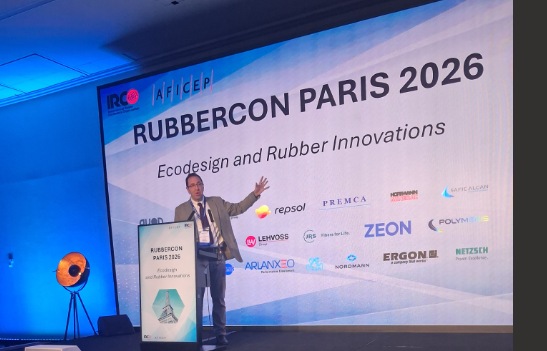
At the recent RubberCon 2026 in Paris, James Busfield, professor of materials at QMUL, detailed the innovative recycling approach that employs chemical inhibitors to preserve the performance properties of vulcanised elastomers.
Current methods of recycling cross-linked NR result in a significant loss of elasticity and other properties of the recyclate, Busfield set out in a presentation to the plenary session of the Paris conference.
In sulphur-cured rubber, the polymer chains are connected by a network of different types of bonds: carbon-carbon bonds which are relatively robust, weaker sulphur-carbon bonds, and sulphur-sulphur bonds which are weaker still.
From this start-point, the QMUL team developed a process through which the weaker sulphur-based crosslinks could be broken and then subsequently re-formed without extensively damaging the polymer chains.
To “reconfigure rather than destroy” the vulcanised network, the QMUL team targeted the reversible di-sulfide bonds of sulphur cross-linked rubber – using copper methacrylate (CuMA) as an inhibitor to control the reaction.
As Busfield explained, the team found that ‘disulphide metathesis’ could be controlled by the inhibitor to generate reactive intermediates that yield reversible, covalently bonded cross-linked networks.
Using solid-state shear milling to selectively break the weaker bonds, they found that by adding CuMA, the properties of the recycled NR could be fully recovered, enabling reuse back into original applications.
Resulting compounds, including carbon black-filled systems, achieved good recycling efficiencies with different sulphur vulcanisation systems.
QMUL is now developing a range of characterisation methods to more fully understand the circularity of these compounds in commercial products.
Research is also continuing into alternative inhibitor systems, with lower-cost and better chemical safety profile – along with industrial collaborations around use of the technology in the recycling of ‘real-world’ compounds.
Reaction mechanism
While the exact mechanism is still under investigation, the QMUL team believes the additive acts by stabilising reactive species long enough for the broken sulphur network to be meaningfully rebuilt during remoulding.
In laboratory trials, moulded rubber sheets were ground down using a lab-scale mill, with the resulting granulate reincorporated into fresh rubber compounds.
As expected, on its own, the recycled crumb introduced defects, weakened the structure and lowered the strength, elongation and modulus properties of the end-material.
However, a formulation containing 90% of the specially recycled material recovered roughly 90% of its key strength and elongation properties, according to Busfield.
"You basically recycled 90% of your material, putting in 10 parts of fresh material with it. What came out had very similar modulus, very similar strength."
The QMUL team then extended its research to more complex, real-world materials, including tire-tread-style compounds containing carbon black and semi-efficient vulcanisation systems.
Even with these more challenging formulations, the inhibitor approach produced impressive results, including near-total recovery in elongation and most of the original strength.
“In filled semi-EV compounds closer to tire tread formulations, Busfield described "almost total recovery of extension-to-break and nearly [full] recovery of strength."
More surprising still, the approach worked even better with carbon black-filled systems, the presenter commenting: "I was not expecting that."
Further encouragement emerged from studies in which the QMUL team cycled a model tire-tread-type compound through multiple rounds of reprocessing, each time blending in fresh material and sending part of the previous generation back around the loop.
"We managed to recycle it and actually from the first to the second to the third to the fourth, recycling the compound didn't change its properties, at least as judged by stress-strain behaviour, reported Busfield.
Further study
But, he acknowledged, “stress-strain curves are not a tire,”: real-world tread materials must withstand abrasion, fatigue crack growth, heat build-up, viscoelastic demands and wet-grip trade-offs.
The QMUL team is, therefore, now further focusing in on those properties, as well as the underlying network chemistry: using swelling studies, cross-link density analysis and selective sulphur-cleavage techniques.
Their aim is to more fully determine that the recycling process is truly targeting sulphur bridges without breaking the polymer chains.
Meanwhile, as copper methacrylate is expensive, carries safety concerns, alternative inhibitors are also under study.
Options here include triphenyl phosphine alone or in mixed systems with only small amounts of the copper-based additive – Busfield indicating commercial progress on this front with industrial partners.
Furthermore, he said, QMUL is examining the effect of inhibitors on other rubber properties, including abrasion resistance, fatigue crack growth, viscoelastic behaviour and wet-grip-related properties.
This work should help determine whether or not the recycled compounds can function in tires and other demanding real-world applications, Busfield concluded.