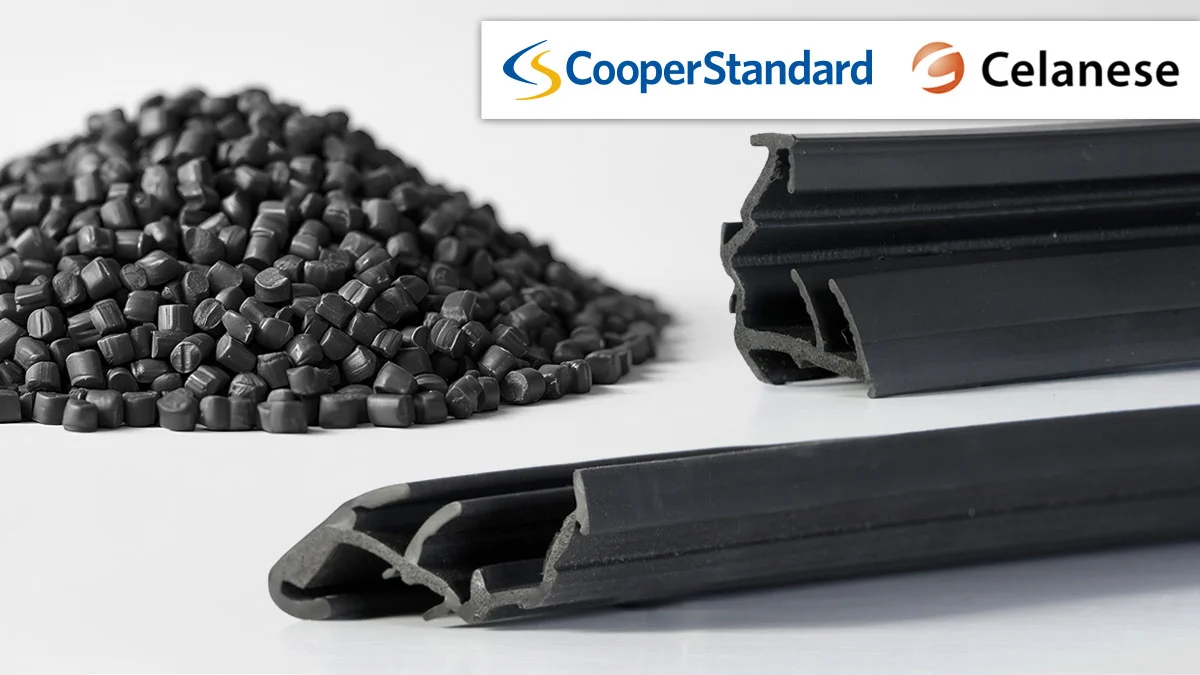
Celanese, Cooper Standard recognised for automotive sealing TPV collaboration
28 Oct 2026
Share:
Partnership saw industry-first application of thermoplastic vulcanisate as alternative to EPDM in glass run channels
Dallas, Texas – Celanese and Cooper Standard have highlighted their collaboration on Santoprene thermoplastic vulcanisate (TPV) technology, which has replaced EPDM rubber in a significant share of automotive window sealing applications.
In a 22 Oct announcement, the partners said their application of Santoprene TPV in automotive glass run channels had been selected for the 2026 SPE Automotive Hall of Fame award.
The technology is claimed to be “the industry's first” to replace thermoset EPDM rubber with TPV in the extruded channels through which vehicle side windows travel.
The development combined material expertise from the Santoprene business, now part of Celanese, with the design and manufacturing capabilities of Cooper Standard's acquired company Jyco.
Jyco, founded in 2000, was an early developer of TPV automotive sealing technology. Cooper Standard acquired its automotive sealing business in July 2013, while Celanese acquired the Santoprene business from ExxonMobil in December 2021.
The original glass run channel collaboration dates back more than two decades, according to the partners.
The statement went on to explain that TPV extrusion required “less capital investment and less production space than rubber processing,” enabling the vehicle manufacturer to switch from EPDM during a mid-cycle programme.
The material change also reduced component weight by 30% – 50% compared with EPDM, through lower density and design optimisation.
Unlike thermoset rubber, TPV production scrap can be reprocessed, while the material can also be recycled at end of life, the companies said.
“Replacing rubber in a glass run channel meant matching the performance of a material the industry had trusted for decades, and doing it in a thermoplastic,” said Todd Elliott, SVP engineered materials at Celanese.
“What made it work was that the material and the part were developed together rather than in sequence,” he added.
The technology has since been adopted across additional vehicle platforms, with TPV now accounting for 55% of the global glass run channel market, according to the companies.
The partners said they continue to collaborate on higher-performance materials and technologies for automotive sealing applications.
This article is only available to subscribers - subscribe today
Subscribe for unlimited access. A subscription to European Rubber Journal includes:
Every issue of European Rubber Journal (6 issues) including Special Reports & Maps.
Unlimited access to ERJ articles online
Daily email newsletter – the latest news direct to your inbox