WRI/Trase study tracks contribution of EU agricultural commodity imports to global deforestation
London – Natural rubber barely registers an impact in a new World Resources Institute (WRI) analysis of the contribution of EU agricultural commodity imports to global deforestation.
With the EU Deforestation Regulation (EUDR) set to apply to large companies from 30 Dec, WRI produced the analysis, drawing on Trase* supply-chain and it's own 'tree cover loss' data.
The findings, stated the Washington, DC-based NGO, "show that just six commodities – beef, palm oil, soy, cocoa, coffee and rubber – accounted for 85% of estimated forest loss linked to EU imports."
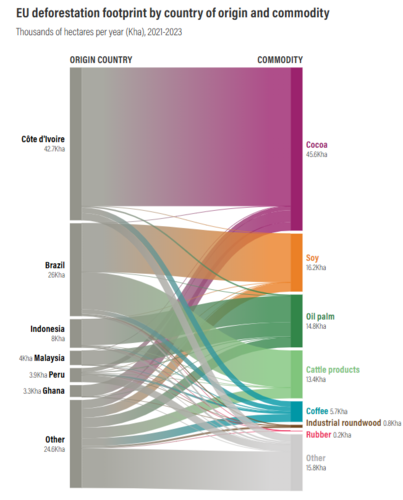
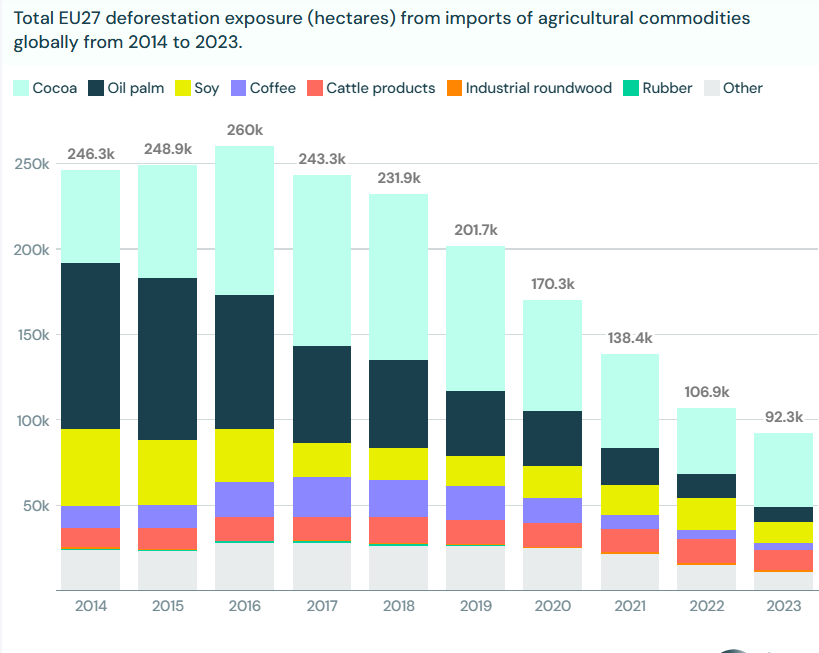
However, despite being cited prominently by WRI, natural rubber is almost a 'no-show' in its charting of the impact of these EU imports on forests globally (see lead image and graphic below).
Within the WRI study, the Trase analysis linked EU imports of agricultural commodities to 112,500 hectares (ha) of deforestation per year between 2021 and 2023.
The EU, said the WRI, is most exposed to deforestation via imports of cocoa from Côte d’Ivoire – 38,800 ha per year, accounting for 40.1% of the EU total.
This is followed by soy from Brazil (13,600 ha, 14.1%), cattle products from Brazil (10,400 ha, 10.8%) and palm oil from Indonesia (7,300 ha, 7.6%).
The WRI/Trase review went on to note that the EU’s deforestation exposure has fallen over time, with the total exposure for 2023 less than half of the value for 2014.
The trend was linked to reduced exposure from palm oil, historically the most important contributor to the EU’s footprint, but now down 91% over the same period.
This, said Trase, reflects much lower rates of deforestation for palm oil in Indonesia, as well as an EU phase-out of palm oil-derived biofuels
While there were more modest declines in deforestation exposure from cocoa, coffee and soy, “the risk from cattle products remained persistent over the period,” added a report summary – which makes no reference to natural rubber.
Major agricultural commodity importing countries face the highest levels of exposure, with The Netherlands – due partly to ‘direct trade’ via the port of Rotterdam – Spain, Belgium, Italy and Germany taking the top places in the study.
“However, their risk profiles differ markedly as The Netherlands and Belgium are most exposed to deforestation from cocoa imports, Spain from soy and Italy from cattle products,” noted Trase.
But, according to the analysis, Germany is actually the most exposed to deforestation when accounting for re-exports, with its footprint increasing particularly for cocoa and cattle products.
Concluded Trase, the latest findings show the "importance of ensuring swift and effective implementation of the delayed EU Deforestation Regulation (EUDR) from next year."
*Trase is a not-for-profit initiative founded in 2015 by the Stockholm Environment Institute and Global Canopy to bring transparency to deforestation and agricultural commodity trade.