IISRP ranks SinoChem, PetroChina as world’s two biggest SR makers in 2026
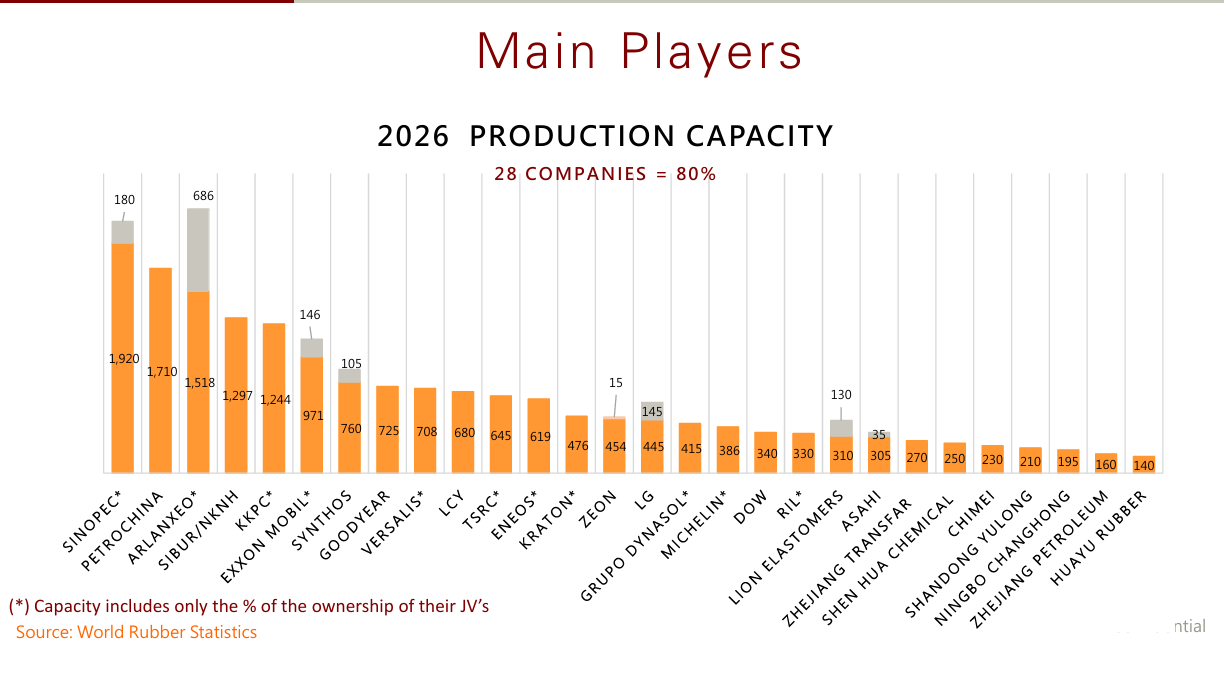
Houston, Texas - Sinopec has again emerged as the world’s largest producer of synthetic rubber (SR) materials, figures from the International Institute of Synthetic Rubber Producers (IISRP) show.
The Chinese petrochemicals major maintained its prior-year ‘active’ capacity level of 1,920 kilotonnes per annum (ktpa), according to the latest data from Houston-based IISRP.
PetroChina registered a 3% year-on-year increase in ‘active’ SR capacity to 1,710ktpa, to move up one slot into second in the annual ranking of rubber/elastomer producers.
Arlanxeo – formerly the dominant global player – fell back one place into third: the Saudi Aramco-owned company registering a 20% year-on-year drop in 'active' SR capacity to 1,518ktpa.
Despite continuing EU sanctions on Russian imports, Sibur/NKNH stayed in fourth position: maintaining its 'active' SR capacity at a prior-year level of 1,297ktpa.
Overall, IISRP estimated 2026 global SR capacity at 22,257kt, with: 36% located in China; 25% rest of Asia, 14%; EMEA, 14%; North America; 9% Russia; and 3% South America.
As well as the “expanding dominance” of Asia Pacific, IISRP noted the market impact of geopolitical tensions and supply-chain disruptions that “continue to affect raw material availability.”
With butadiene rubber, for example, the analysis puts supply/demand percentages for at 64/65 in Asia Pacific, 21/18 in EMEA and 15/17 in the Americas. The operating rate was estimated at around 76% in 2025
For SSBR (solution styrene butadiene rubber), the equivalent figures were: 53/48 in Asia Pacific, 23/28 in EMEA and 24/25 in the Americas. The operating rate was estimated at around 68%.
For EPDM, the supply/demand balance was estimated at: 47/45 in Asia Pacific, 18/30 in EMEA and 35/25 in the Americas. The operating rate was estimated at around 74%.
Summarising, IISRP said global growth “remains resilient but uneven in 2026, with Asia driving expansion, while advance economies lag behind.” It cautioned that “downside risks dominate, with geopolitics, inflation, and financial stress posing the biggest threats to 2026 growth.
More positively, the institute saw “strong ‘emerging market’ growth driving global expansion” as well as potential upsides around energy transition, infrastructure investment and improved productivity linked to AI & digitalisation.
This article is only available to subscribers - subscribe today
Subscribe for unlimited access. A subscription to European Rubber Journal includes:
Every issue of European Rubber Journal (6 issues) including Special Reports & Maps.
Unlimited access to ERJ articles online
Daily email newsletter – the latest news direct to your inbox