India, China lead as largest EU carbon black suppliers after Russia sanctions
Tyres Europe report identifies ‘modest risk of harmful interruption' in synthetic rubber supply
Brussels – Europe’s tire industry has significantly diversified its carbon black sourcing following the loss of Russian supplies two years ago, according to a new study commissioned by Tyres Europe.
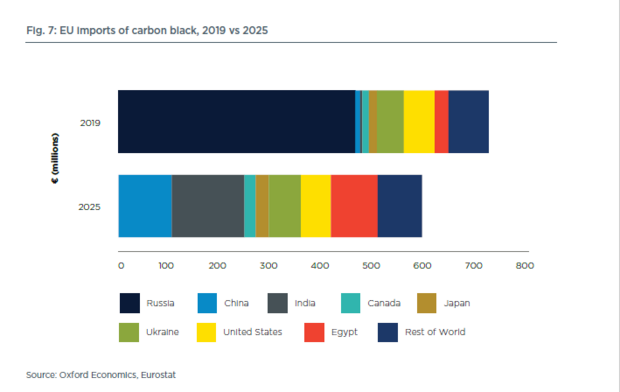
Russia accounted for around 60% of EU carbon black imports before sanctions were introduced after Moscow's 2022 invasion of Ukraine, said the Oxford Economics study 28 Sept.
The EU ban on Russian carbon black entered into force in July 2024 and was subsequently extended to Belarus, forcing “rapid sourcing adjustments”.
According to the report, by 2025, imports from Russia had stopped, while shipments from China, India and Egypt had increased significantly, with India becoming the largest source of EU carbon black imports.
At the same time, EU carbon black production increased 34% between 2019 and 2024, with “notable gains” in Germany, Hungary and Italy.
“Carbon black provides an example of how the industry has responded to supply disruption through diversification of the country of supply,” Oxford Economics said.
The report added that the shift illustrated both “the risks of over-reliance on a single supplier nation” and the ability of EU buyers “to pivot when forced to do so.”
The report also identified a significantly lower supply risk for synthetic rubber, with 60% of the material consumed by EU tire manufacturers produced within the bloc and 40% imported.
Of the synthetic rubber sourced by tire makers from within the EU, Germany and Poland each accounted for 30%, while Belgium and the Czech Republic each represented around 10% of supplies.
Non-EU supplies were also relatively diversified, according to Oxford Economics, with the US, Japan, South Korea, the UK and China accounting for 68% of imports in 2024.
Another 31% came from 12 economies across the Americas, Europe, the Middle East and Asia.
The study therefore concluded that “the risk of a harmful interruption to synthetic rubber supplies is relatively modest”.
This contrasts the industry’s position with natural rubber supply, for which EU tire manufacturing is entirely dependent on imports and more than 90% of supply is concentrated among five countries.
This article is only available to subscribers - subscribe today
Subscribe for unlimited access. A subscription to European Rubber Journal includes:
- Every issue of European Rubber Journal (6 issues) including Special Reports & Maps.
- Unlimited access to ERJ articles online
- Daily email newsletter – the latest news direct to your inbox
- Access to the ERJ online archive