Product employing 43% recyclate ‘shows need for regulators to support circular value-chains…’
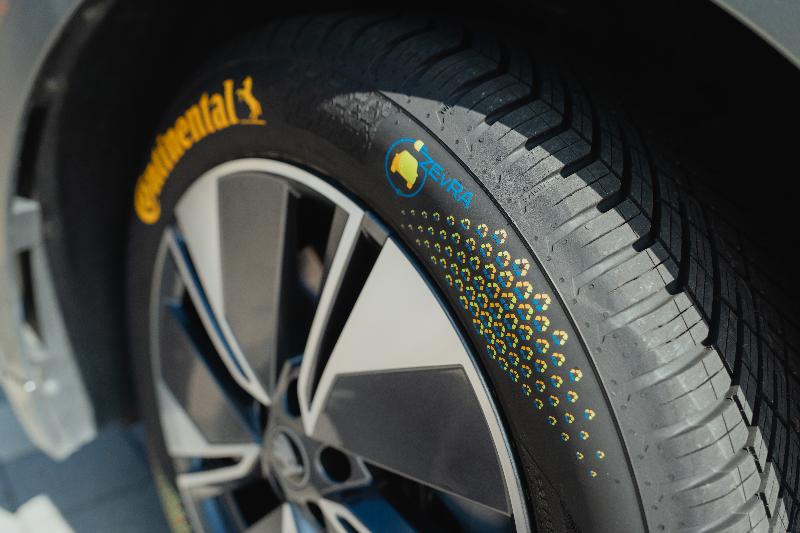
Hanover, Germany – Continental has developed a concept tire made from around 43% recycled materials, as part of the EU-funded ZEvRA (Zero Emission Electric Vehicles Enabled by Harmonized Circularity) project.
As well as showing the potential of innovative material approaches, the tire also “demonstrates the need for a reliable framework” when adopting recycling technologies at industrial scale, according to a group release.
“Circular materials can help save resources and energy while reducing GHG emissions… [and] are key to making mobility more sustainable,” said Dr Andreas Topp, head of platform development and industrialization for passenger-car tires at Continental.
Scheduled to conclude this year, the two-year ZEvRA project is aimed at optimising the circular economy of EVs along the entire value-chain, explained Continental – the only tire maker within the consortium.
The ZEvRA tire includes recycled tall oil, steel, rubber from end-of-life tires, polyester fibre made from recycled PET bottles, as well as recovered carbon black (rCB) from end-of-life tires. Meanwhile, foundry residue sand is used to manufacture an alternative silica variant.
Also incorporating around 13% of renewable raw materials and 25% mass-balance-certified materials, the tire is claimed to combine sustainability and performance – including the “highest rating” for rolling-resistance under the EU tire labelling scheme.
But the ZEvRA project “shows that technological progress can only achieve its full impact when reliable, aligned frameworks provide planning certainty and support the market ramp-up of new processes,” according to Topp.
This, he believes, requires “standard European-wide definitions for recycled materials, as well as clearly defined criteria stipulating when processed substances are classified as recycled raw materials.”
Continental also wants greater “technological openness” and more resilient and internationally coordinated supply-chains to ensure the delivery of high-quality recycled raw materials in sufficient quantities.
The next step is to establish innovative recycling technologies on an industrial scale and set up closed material flows, according to Jorge Almeida, head of sustainability for Continental’s Tires group sector.
Almeida underlined the need for a standardised approach to carbon-footprint calculation and reporting, developed through close dialogue between policymakers and stakeholders.
“If implemented through regulation, it must be simple, transparent and easy for consumers to understand in order to promote genuine progress rather than create unnecessary bureaucracy,” he advised.
According to the group’s 25 Aug release, the share of purchased renewable and recycled production materials in Continental’s tire portfolio is set to rise from 28% in 2025 to at least 40% by 2030.
This article is only available to subscribers - subscribe today
Subscribe for unlimited access. A subscription to European Rubber Journal includes:
Every issue of European Rubber Journal (6 issues) including Special Reports & Maps.
Unlimited access to ERJ articles online
Daily email newsletter – the latest news direct to your inbox