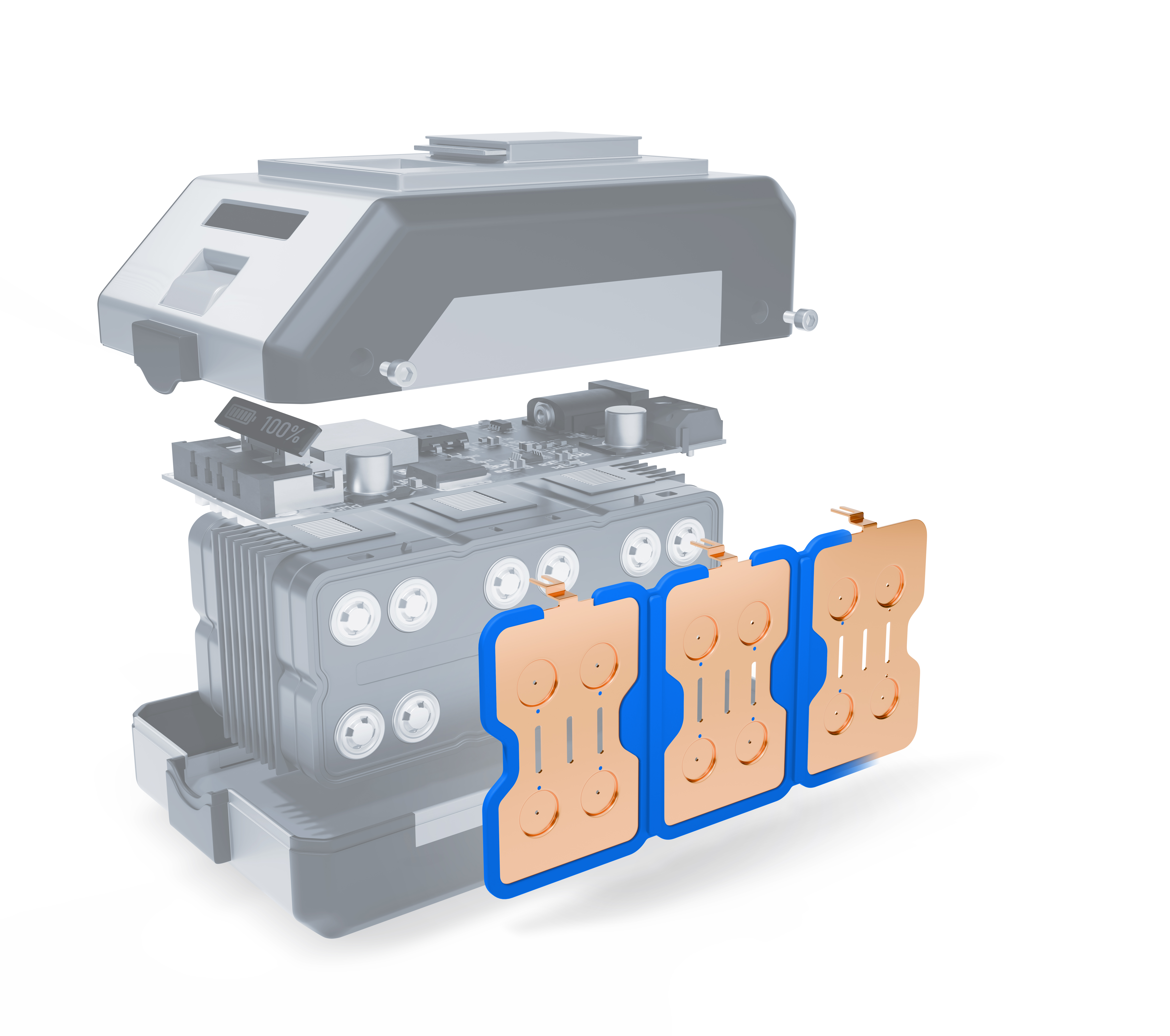
FST elastomer-based seals are integrated in a “single concept” to minimise failure risks
Freudenberg Sealing Technologies (FST) has developed new elastomer-based connector seals which it claims can support the latest technological advancements in modern battery packs.
According to the German seals maker, modern battery packs – increasingly in demand due to fast-paced electrification trends such as electromobility, humanoid robots and consumer applications – must meet highly demanding requirements for the mobile, safe and efficient provision of energy.
This, FST explained, creates an intensifying challenge for battery developers: Batteries need to become more compact, robust, powerful and better protected, while the cost pressure on the overall system continues to rise.
“Every additional component, interface and assembly step can amplify the complexity, tolerance risks and costs,” said FST in an 18 Aug release.
According to FST, conventional battery architectures are increasingly reaching their limits because key functions – such as electrical contacting, sealing, mechanical fastenings, protection against environmental influences and required safety concepts – are often designed and implemented separately.
Integrated function: Cell-contacting architectures in modern battery packs
According to FST, ‘connector seals’ open the door to a new type of cell contacting.
They are based on multifunctional, modular cell connector plates for cylindrical, prismatic or pouch cells.
These cell connectors are manufactured to customer specifications from nickel-plated or tin-plated copper and overmoulded with elastomer.
The elastomer components offer “high levels of electrical insulation” while meeting “all requirements of modern battery systems.”
The new system allows to directly integrate different seals and seal geometries – such as for housing seals, cell seals or other protective features – based on customer requirements.
FST went on to say that the additional functional integrations enhance the component’s value and create a cell connector that provides both electrical function and offers advantages in terms of assembly, installation space, robustness, damping and system integration within the battery pack.
Refined: From individual component to platform concept
The key benefit of connector seals lies in their capability for integration: Functions that were previously handled by separate components for contacting, sealing, insulation and mechanical guidance are now combined in a single concept.
This reduces interfaces, shortens tolerance chains and minimises potential failure risks.
Here, FST explained, the focus has shifted from individual components to a modular platform approach in which electrical, mechanical and sealing functions are considered together “right from the start.”
Furthermore, the concept covers more than lithium-ion batteries.
“Regardless of cell chemistry, pack architecture or application, the full range of design possibilities offered by the functional integration and new technology can be utilised,” FST claimed.
As a result, connector seals create new design options for battery developers and enable new architectures for future battery packs.
Bonding system: Skipping the wet-chemical pre-treatment
The concept of the connector seal was complemented by Freudenberg Adhesive Clean Technology (FACT) which offered a “clean and efficient bonding system.”
The system enables the elastomer to be permanently adhered to the cell connector surfaces, which typically resist bonding.
The process eliminates the conventional wet-chemical pretreatment, enabling benefits such as resource-conserving manufacturing process and reduced dependence on bonding agents in the supply chain.
Another advantage, FST said, is that the sealing system offers “virtually complete design freedom for the connector.”
For customer-specific battery applications, this allows for a targeted approach to different cell formats, pack architectures and requirements.
This means that sealing functionality, electrical conductivity, insulation, weldability and resistance to electrolytes and other battery-specific media can be combined in a single integrated component.
“Our goal is to rethink battery systems as an architectural whole. This works best when we are involved in the concept development from the very beginning,” said Martin Knoll, head of R&D integrated moulding components at FST.
With such a process, Knoll added, not only cell connectors are optimised but also a “more efficient and cost-effective overall system” is created.