'Hybrid' plant in Mexico set for start-up early 2027, supported by low-cost units in China and India
Tokyo – Yokohama Rubber Co (YRC) has outlined its new mid-term plans, which will see significant expansion and restructuring of its global tire production network over the next three years.
Labelled YX2029, the group's strategy targets new production facilities, an expanded Indian operation and further transition towards premium and off-highway tires.
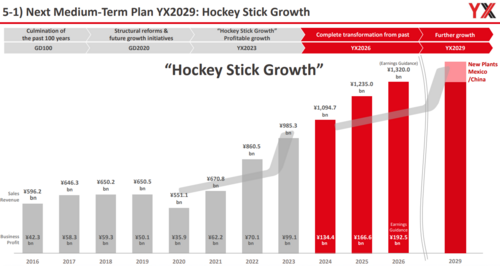
The plan, from 2027 through to 2029, will represent YRC's next stage of "hockey stick" growth, with new plants in Mexico and China contributing to the mix.
Mexico start-up
A key element of the plan is YRC's new manufacturing facility in Saltillo, Mexico, which is being developed as a 'PCR/OHT hybrid' facility. (ERJ report)
The $500-million (€433 million) plant is designed for a total annual production capacity of 5 million passenger car (PCR) tires and 11 kilotonnes of off-highway tires (OHT).
Mass production at the facility is scheduled to start in January 2027 with an initial capacity to produce 2 million PCR units per year.
Comparing production costs between the Mexican facility and YRC's Salem plant in Virginia, the group said it expects to cut costs by 55% during the initial 2-million tire production phase.
At the plant's full 5-million-unit capacity, YRC expects production costs to be 71% lower than at the Salem plant.
The company said the initial 2-million-unit production phase would deliver a $55 million reduction in production costs.
YRC added that the Salem plant, with an annual manufacturing capacity of about 6.5 million passenger and light truck tires, has been closed since March. (ERJ report)
China, India expansions
Another key part of the growth strategy will be YRC's new production unit in Hangzhou, China, as part of a relocation process in the city. (ERJ report)
The unit – ultimately designed to produce 14 million units/year – currently produces 6 million units/year with an ongoing project to expand capacity to 9 million units by 2028, said YRC.
The Japanese group said that it started mass production at the facility in March and expects the plant to generate an additional $30 million in profits, compared to its old unit in the city.
India is another part of the group's low-cost production strategy with the Vizag 'PCR/OHT hybrid facility', which YRC said started its PCR production line last year.
Overall, the plant has a capacity to produce 1.7 million PCR units and 43ktpa of OHT tires per year.
YRC said it invested roughly $420 million in the Vizag plant over three phases in just over a decade.
Product mix
The manufacturing investments are closely linked to YRC's strategy of increasing the proportion of higher-value products while also reducing production costs for standard products.
According to YRC, Chinese manufacturers accounted for 42% of global consumer-tire production in 2025, with the figure set to rise to 52% by 2030.
The group, therefore, expects continued pressure from Chinese producers and is examining low-cost production as a means of maintaining competitiveness.
At the same time, YRC plans to increase the contribution of its premium Advan, Geolandar and Winter (AGW) products from 47% of total sales to 50% by 2029.
YRC also highlighted that its consumer tire production capacity has increased substantially over the longer term, from 56 million tires in 2012 to around 60 million in 2025.
According to the medium-term plan, group capacity is expected to further rise to 61 million in 2026, 62 million in 2027 and 63 million in 2028 and 2029.
OHT growth
For its OHT business, YRC has set a target of Yen70 billion in business profit in 2029, compared with Yen31.3 billion in 2025 and a Yen41.9 billion forecast for 2026.
The group linked the OHT growth outlook partly to agricultural machinery tire demand, citing a Smithers report forecasting a recovery in market demand towards 2029.
Meanwhile, YRC is planning further changes to its OHT production allocation, with the transfer of production currently supplied by Goodyear across its global production footprint by 2030. (ERJ report)
The planned network includes a new OTR facility in India, a shift between the company's Japanese Onomichi and Tatsuno plants, production at the Mexico hybrid plant, and an idled Romania OTR plant which was recently acquired.
The group expects the changes to reduce its OTR production costs by 22% by 2030 compared to the baseline of 2025.