Colour-changing tactile sensor enables robots to ‘see’
10 Jul 2026
Share:
QMUL: Elastomeric sensor design “moves sensing into the material itself...”
London – Engineers at Queen Mary University of London (QMUL) have developed a colour-changing tactile sensor than enables robots to “see” and touch in real-time, the university has announced.
Invented by Giacomo Sasso, a postdoctoral researcher at the school of engineering and materials science at QMUL, the sensor works by transforming invisible forces into dynamic colour patterns.
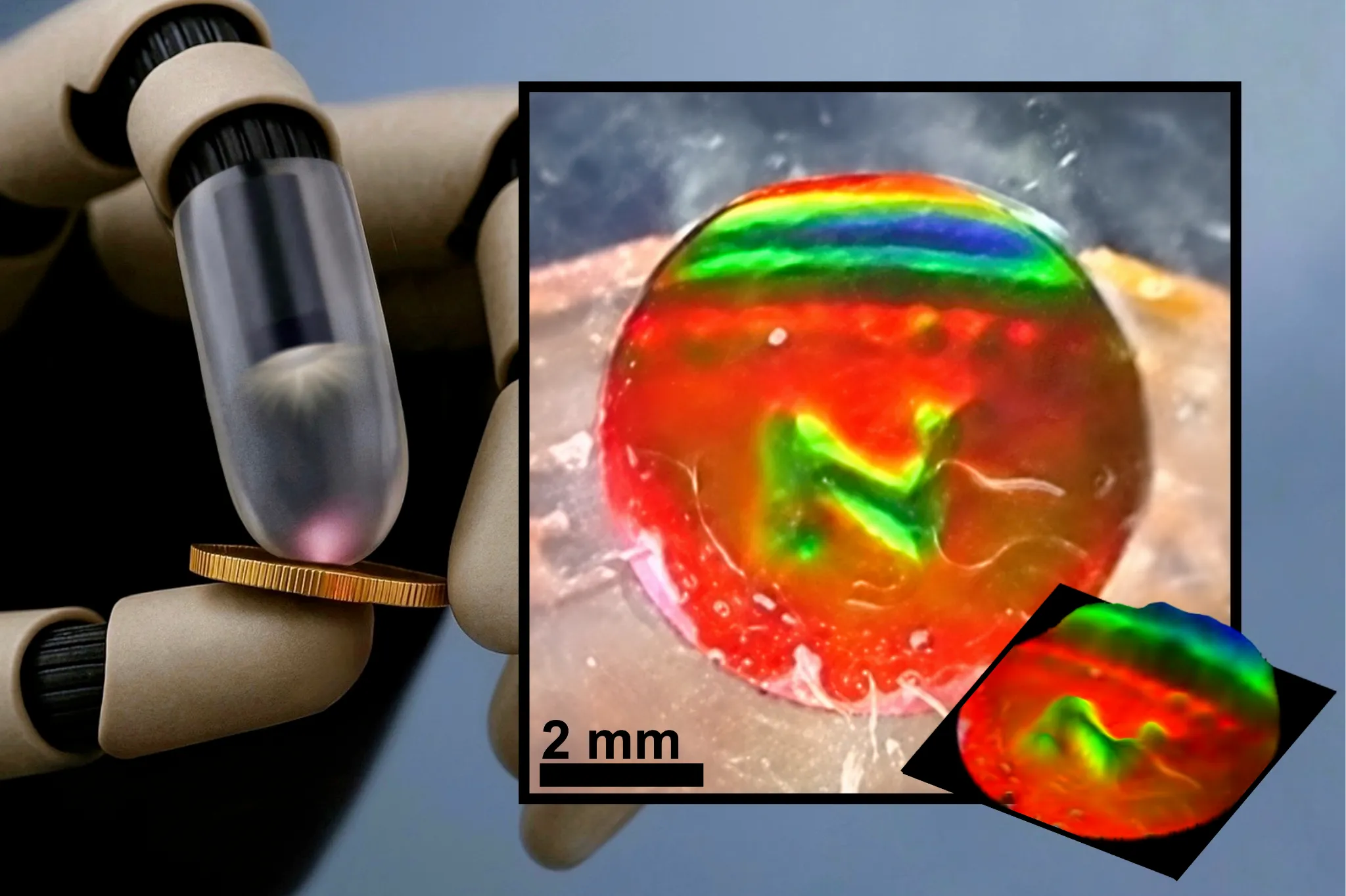
Mechanical interactions are transformed into spatially varying colour fields that a low-cost USB camera can capture and read in real-time, according to the university’s 3 July release.
The sensor comprises a mechanochromic elastomeric layer, sandwiched between two additional elastomeric layers: a black, outer-surface one and a transparent inner layer facing the camera, a research paper* shows.
To enhance the mechanochromic layer’s deformation and colour-changing effects, it adds, the three soft layers have to be coupled to a much stiffer transparent substrate.
The device is described as a “stretchable mechanochromic Bragg reflector embedded between two soft silicone layers – the paper showing generated topological maps of a fingertip, a one-penny coin, and a leaf, of around 100 micrometre resolution.
According to the QMUL release, robotic grippers employing the new sensors can track subtle variation in force, pointing to applications in the precision assembly of micro-scale components.
Healthcare is another potential application area, for example giving artificial limb a “richer sense of touch during delicate daily or clinical tasks,” the university added.
“Simultaneously, it can allow surgical systems to distinguish healthy from abnormal tissue by reading fine pressure signatures directly through the material’s colour response,” it stated.
“A human hand contains more than 10,000 mechanoreceptors to do the job, yet touch sensing remains one of the major challenges in robotics,” said Sasso, noting that the new technology can “reproduce such sensor density at comparable scale and simplicity.”
Instead of the conventional approach of embedding dense and “overengineered” sensor arrays, the design moves sensing into the material itself, the inventor further explained.
“Mechanical cues are directly transformed into colour fields, producing rich pressure maps while simplifying the system architecture,” said Sasso.
“What is particularly powerful is that the information is already in the light signal. You are no longer reconstructing touch - you are observing it directly.” prof James Bustfield of QMUL coomented in the release.
The development project, noted QMUL, also involved researchers from the University of Florence, University of Trieste and University of Trento in Italy.