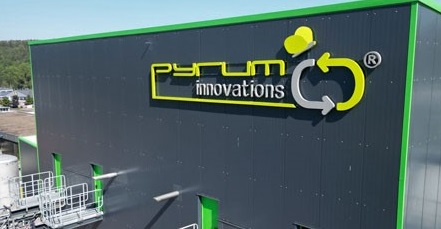
Pyrum's second German project regains momentum following early delays
1 Jul 2026
Share:
CEO says stable rCB production clears key hurdle as company advances expansion projects
Dillingen, Germany – Pyrum Innovations has announced that its planned tire recycling plant at Perl-Besch, Germany is moving ahead after delays caused by the need to prove stable production at its flagship end-of-life tire (ELT) pyrolysis plant in Dillingen.
Speaking in recent a company podcast, CEO Pascal Klein said work on the project had accelerated following the successful optimisation of Dillingen's milling and pelletising plant, which had initially failed to meet performance expectations.
The company announced the groundbreaking for the Perl-Besch plant in November last year, but progress subsequently slowed.
"The first reason is that nobody is ready to provide the money – not the investors, not the customers and not the bank – if the plant in Dillingen has not been proven," Klein said.
According to Klein, it took until May this year to prove that every step of the process in Dillingen works.
Since then, "everything sped up again," he continued. "The banks reactivated everything and our customers did the same."
Klein described the completion of the milling and pelletising plant as one of Pyrum's most significant achievements over the past year.
The company has now achieved the “most important” objective, he said: producing recovered carbon black (rCB) that is “selleable and meets the quality requirements of the customers."
He added that the plant is now producing "stable oil, stable gas, stable energy, and stable rCB," with product quality and process reliability now established.
The remaining 10% of the Dillingen ramp-up, Klein explained, is the quantity of rCB that comes out at the end, which according to the CEO can be addressed by increasing volume.
To increase throughput, Pyrum is installing two additional conveying lines between the mill and pelletiser over the summer.
While work at Perl-Besch slowed during the first quarter, Pyrum used the time to redesign the next generation of its plants through a value engineering programme.
The exercise aims to simplify construction, shorten build times and offset inflationary pressures.
"We took the whole knowledge of the last years and redesigned the plant to make it cheaper... and quicker to build," Klein said.
"I'm not saying that the plant will be cheaper than it was planned, but it helps us enormously to stay in budget."
The revised engineering is expected to be completed by the end of June, after which Pyrum plans to begin ordering equipment for the Perl-Besch project.
Klein added that the improvements will also support the company's planned projects in the Czech Republic and Greece, both of which had also been awaiting proof of stable production at Dillingen.
This article is only available to subscribers - subscribe today
Subscribe for unlimited access. A subscription to European Rubber Journal includes:
Every issue of European Rubber Journal (6 issues) including Special Reports & Maps.
Unlimited access to ERJ articles online
Daily email newsletter – the latest news direct to your inbox