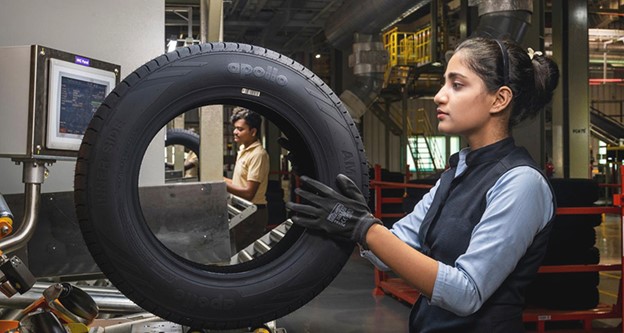
Apollo Tyres pressing ahead with India, Europe expansion plans
22 May 2026
Share:
Market demand remained strong through April despite macroeconomic uncertainty
Gurugram, India – Apollo Tyres has announced that it will continue with planned capacity expansion projects in India and Europe after reporting utilisation rates of around 90% across both regions.
Speaking during the group’s 15 May full-year earnings call, chief financial officer Gaurav Kumar said demand remained strong despite ongoing macroeconomic uncertainty and volatility in global markets.
“Through April, we struggled in terms of keeping up with the demand,” Kumar told analysts, adding that the company expects “full capacity utilisation” going forward.
For fiscal year 2027 (started 1 April), Apollo has outlined capital expenditure of INR35 billion (€370 million), with around 80% allocated toward growth and capacity expansion projects.
According to Kumar, close to INR30 billion of the planned investment will be directed toward India, where Apollo is expanding both passenger car radial (PCR) and truck and bus radial (TBR) tire production capacity.
The remaining investment will primarily support expansion of passenger car tire production at Apollo’s Hungary plant in Europe, where the company said work is already underway.
Apollo indicated that while some flexibility exists for future spending plans, most fiscal 2027 investment commitments are already fixed.
“If we see slowing down, we would have some flexibility for FY’28,” Kumar said. “FY’27 would largely be committed.”
The latest comments follow Apollo’s announcement in February of a broader INR58 billion investment programme covering fiscal years 2027 to 2029.
The previously announced investment targets expansion of PCR and TBR production at the group’s Andhra Pradesh facility in India.
At the time, Apollo said the programme would increase India PCR production capacity by around 18% and TBR capacity by more than 20%. (ERJ report)
The company previously stated that utilisation rates in India were already in the “high 80s”, with management warning that capacity constraints were beginning to emerge due to sustained demand growth
This article is only available to subscribers - subscribe today
Subscribe for unlimited access. A subscription to European Rubber Journal includes:
Every issue of European Rubber Journal (6 issues) including Special Reports & Maps.
Unlimited access to ERJ articles online
Daily email newsletter – the latest news direct to your inbox