Cologne, Germany – Artificial intelligence is no longer a distant prospect for the tire manufacturing industry: it is already reshaping how tires are designed, made, sold and recycled.
That’s according to AI strategy developer Sanjay Sauldie, who adds however that while “the rhetoric around AI often veers toward revolution, reality on the factory floor points more evolutionary change than any overnight disruption."
Nevertheless, tire companies that fail to adopt AI risk being left with structurally higher costs and weakened competitiveness, warned Sauldie, noting that profound changes are already taking place in R&D and materials science.
“AI is accelerating what has historically been one of the slowest parts of the value chain: compound development,” said the AI expert. “Instead of relying solely on laboratory trial & error, tire makers are increasingly using AI to simulate the behaviour of new rubber formulations before they are ever produced.”
So, development cycles that once took years can now be compressed into months, while the number of potential materials combinations explored has expanded exponentially, according to the presenter.
Meanwhile, virtual testing of tires is replacing physical validation, Sauldie citing how AI simulation platforms can run thousands of test scenarios – covering everything from aquaplaning to high-speed thermal stress – within hours.
Also accelerating speed-to-market are generative AI tools that can produce and evaluate thousands of tread patterns simultaneously: balancing competing requirements such as rolling resistance, grip and noise.
Factory evolution
Sauldie was more guarded about the potential for an AI-driven 'revolution' in tire manufacture, commenting that “industry insiders remain sceptical” about the prospects for significant change, at least in the near-term.
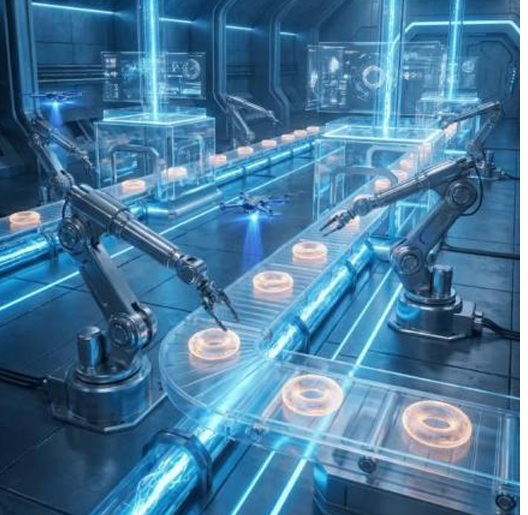
More likely, he said, is a move to ‘hybrid’ tire factories: plants that are smarter, more efficient and increasingly data-driven, but still reliant on skilled human operators.
“Rubber is a difficult material: sensitive to temperature, variable in behaviour and unforgiving in processing, explained the AI strategy developer, “That complexity still demands human oversight.”
Instead, he said, AI is finding its place in targeted applications, for example vision systems that can detect microscopic defects, internal inconsistencies and deviations in tread geometry far more consistently than manual inspection.
Predictive maintenance is another promising area, where by analysing sensor data from machinery, AI systems can identify wear patterns weeks before failure occurs—cutting costly downtime and disruptions.
In the area of energy-management, meanwhile, the technology can “dynamically adjust production schedules and energy usage, helping manufacturers reduce both operating costs and emissions,” said Sauldie.
Data platform
Perhaps the most visible transformation is happening once tires leave the factory, as they are increasingly becoming connected devices with embedded sensors that monitor pressure, temperature, wear and load in real-time and feed data back to AI systems.
These predictive capabilities are already reducing breakdowns and improving safety, as evidenced by fleet operators who report fewer failures, longer tire life and better fuel-efficiency, said Sauldie.
Retail is also being reshaped, as AI-powered systems can recommend tires based on vehicle-type, driving behaviour and weather conditions, as well as enabling virtual assistants to better handle appointment bookings and manage seasonal peaks.
AI is also beginning to address one of the industry’s most persistent challenges: sustainability, continued the presenter.
Recycling technologies, he said, "long constrained by technical limitations, are being enhanced by AI-driven process control. Advanced systems can sort materials more accurately and optimise devulcanisation, enabling recycled rubber to approach the quality of virgin material."
Meanwhile, digital product passports – tracking a tire’s lifecycle from raw material to disposal – are moving closer to regulatory reality in Europe. These systems, suggested Sauldie, promise greater transparency, but also require robust data infrastructure.
AI, he said, is also playing a role in securing future raw material supply: "From bio-based rubber alternatives to fermentation-based production processes, data-driven optimisation is helping reduce dependence on traditional sources."
Future outlook
Looking at the pipeline of AI-driven innovation, Sauldie cited self-healing tires, adaptive tread patterns and fully integrated tire–vehicle communication systems as promising prospect, at least longer-term prospects.
More immediately, the industry is moving toward closed-loop systems, where data from tires in use feeds directly back into design and production. This continuous feedback cycle has the potential to accelerate innovation and improve product performance with each generation.
Concluded Sauldie, for tire manufacturers, the question is now about how quickly and effectively AI can be deployed and the competitive benefits realised, in terms for example of faster development, lower costs and more responsive supply-chains.
But, he emphasised, “adoption is not simply a matter of technology. It requires new skills, new processes and, in many cases, a shift in organisational mindset.
“For an industry built on incremental gains, AI represents something different: a systemic change that touches every part of the value chain. The challenge now is to turn potential into practice—without losing sight of the realities on the ground.”