Replacement demand offsets weaker OE performance, keeps sales stable at constant exchange rates
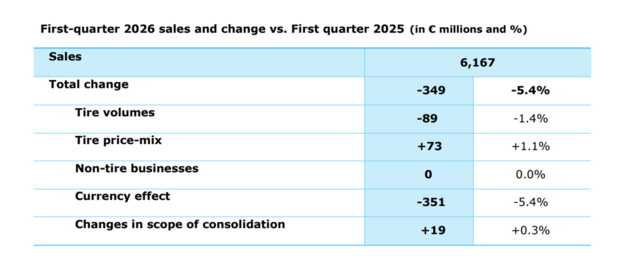
Clermont-Ferrand, France — Michelin has posted first-quarter group sales of €6.17 billion, down 5.4% year-on-year, on adverse currency effects as the euro strengthened against the US dollar and most other currencies.
At constant exchange rates, sales were stable, the French group reported 29 April, adding that it had delivered a “solid performance in the first quarter” despite a “highly uncertain environment.”
Over the three months to end of March, volumes declined a “modest” 1.4%, while replacement demand improved and premium mix remained supportive.
“Replacement sales increased, boosted by a strong performance from the Michelin brand (+3% in volume),” Michelin stated.
A favourable mix effect of 1.9% was driven by ‘consumer segment’ (passenger car, light vehicle and two-wheeler tires) product mix and “a positive business mix evolution.”
The gains, it said, partially offset lower pricing linked to contractual indexation clauses following the fall in raw material costs during 2025.
Consumer sales down 4.4%
Sales in Michelin’s consumer segment totalled €3.40 billion, down 4.4% year-on-year, but up 1.3% on a constant currency basis.
Passenger car and light truck tire volumes rose 1%, supported by strong replacement market demand and market share gains.
The group said Michelin-brand replacement sales rose 6%, while OE sales continued to weaken amid soft vehicle markets.
The group cited a 4% decline in global OE demand, including a 12% fall in China.
“The structural product mix enrichment continued,” Michelin said, with 18-inch and larger tires accounting for 69% of Michelin-brand sales during the quarter.
The group added that Michelin gained market share in most regions and expanded its presence in digital sales channels, particularly in China.
Two-wheel tire sales also rose strongly, especially in “moto leisure and premium scooter segments.”
TBR declines on truck OE weakness
Michelin’s ‘transportation segment’ covering truck & bus tires as well as connected solutions saw its revenue fall 11.3% year-on-year to €1.36 billion.
Michelin attributed 6% of the decline to lower volumes and 4% to currencies.
Truck OE demand remained weak, especially in North America and South America.
Michelin said North and Central America OE truck tire demand dropped 19% compared to the first quarter of 2025, while South America saw a 16% decline.
The group said North America remained “the most difficult market,” with the Class 8 truck segment “still under pressure” and demand reaching “a cyclical low during the quarter.”
Replacement truck tire sales improved in Europe, supported by product renewals and multi-brand strategy execution.
However, North American replacement demand remained subdued due to weak freight activity and cautious dealer purchasing.
Michelin added that Connected Solutions revenue was slightly lower year-on-year, although Michelin Connected Fleet continued expanding in South America.
Specialities dip
Sales in the Specialities segment, which includes mining, off-road and aircraft tires, fell 3.3% to €1.08 billion, although volumes increased 2.5%.
Mining tire sales increased in “a growing market”, while aircraft tire sales were up, not yet impacted by the Middle East conflict.
Beyond-road activities were described as “stabilised on a comparable basis,” despite continued weakness in agricultural OE demand.
“The main points of vigilance,” said Michelin, remain agricultural tires, particularly the tracks sub-segment, and materials handling tires.
Non-tire gains
Michelin’s newly separated Polymer Composite Solutions segment posted first-quarter sales of €326 million, up 5.1%.
Michelin noted “strong growth” in ‘seals’ business, driven by a strong performance in hydraulic applications, as well as in the sub-segments linked to gas compression and aeronautics applications.
Overall, the group said the segment’s sales growth was underpinned by its positioning in “technically advanced applications.”
Growth in ‘coated fabrics and films’ sales was driven by diversification initiatives to develop coated fabrics markets beyond marine applications and by the resumption of certain automotive programmes.
Sales in the ‘belts’ business were “slightly up,” notably in certain industrial applications and in aerospace.
Sales of ‘conveyors’ declined against a backdrop of market pressures in Australia due to the downturn in the Chinese construction market, and due to maintenance operations carried out during the quarter at one factory.
Currency impact
Michelin said the biggest negative currency effect came from the US dollar, with the Turkish lira, Japanese yen and Chinese yuan also weighing on reported figures.
“All the operating segments were affected by this adverse exchange rate environment, which masked the underlying businesses’ performances in local currency,” it said.