Freudenberg develops ‘non-wet’ adhesive system for surface bonding
23 Apr 2026
Share:
FACT process eliminates solvents, claimed to cut carbon emissions dramatically
Weinheim, Germany — Freudenberg Sealing Technologies (FST) has developed a ‘non-wet’ adhesive system that enables bonding between elastomers and substrate parts made of ferrous and non-ferrous metals, as well as plastics, without the use of wet-chemical processes.
The system, branded Freudenberg Adhesive Clean Technology (FACT), replaces conventional solvent-based surface treatments with a dry process that modifies component surfaces at ‘a microscopic level,’ said FST 22 April.
This process makes ‘FACT’ “immediately ready for vulcanisation or the bonding of elastomers,” the company said.
The “fully automated” process is designed to support bonding across a range of material combinations, regardless of layer thickness or surface functionality.
The resulting components, said the company, retain weldability, electrical conductivity and resistance to media including oils, water, hydrogen and AdBlue.
The technology was developed in collaboration between Freudenberg Technology Innovation and Freudenberg Sealing Technologies
According to Dominik Langore, manager surface technology EU at FST, T&I, the initiative has so far proven successful and has reached “market maturity.”
In particular, the environmental impact of the coating process is “significantly reduced,” Langore explaining: “A key factor in the products’ environmental footprint is the elimination of solvents, which were previously required in the material formulations.”
Even the binders, which previously could contain more than 90% solvents, are no longer necessary, he added.
“This eliminates the need for a wide range of substances that are potentially hazardous to health and the environment,” said the FST specialist.
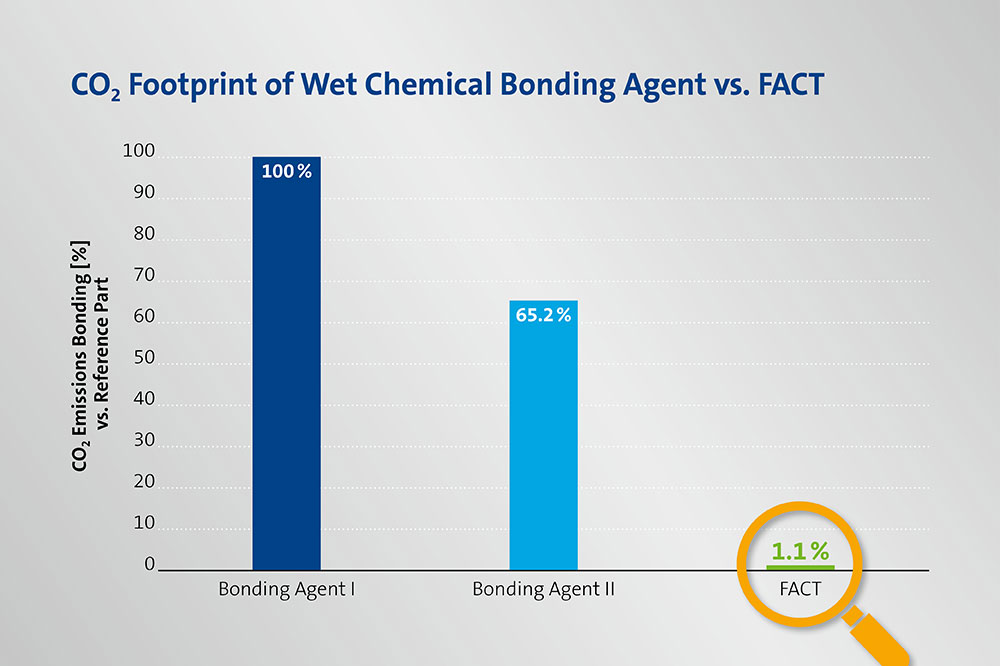
FST said it carried out a life cycle assessment, wherein the CO2 emissions of a reference process were tested for three coating methods.
The most emission-intensive wet chemical process was taken as the 100% reference value.
A comparative process using a different binder caused 65.2% of the reference emissions.
With FACT, CO2 emissions “can be reduced to 1.1% of the reference value,” said FST.
“With every process step we eliminate… we also reduce the number of potential errors throughout the entire manufacturing process,” Langore said.
This is advantageous from a supply chain perspective, as the required components are multi-sourced and thus not subject to single-source dependency.
The company added that adhesion and flexibility are maintained under high loads and at temperatures down to -40°C, “without forming microcracks.”
Meanwhile, online monitoring enables traceability and quality control in the process.
Freudenberg said the technology could be used across “virtually all motorised drive and energy storage systems”, including automotive, marine and aviation applications, as well as battery systems.
This article is only available to subscribers - subscribe today
Subscribe for unlimited access. A subscription to European Rubber Journal includes:
Every issue of European Rubber Journal (6 issues) including Special Reports & Maps.
Unlimited access to ERJ articles online
Daily email newsletter – the latest news direct to your inbox