Hanover, Germany — Global tire production is expected to continue growing slowly at around 1–2% annually, reflecting a mature market in developed economies, shifting demand toward emerging regions and competitive pressure from low-cost producers.
Speaking at the Tire Technology Expo in Hanover, Robert Simmons, director of tire & rubber research at GlobalData, said international trade in tires from lower-cost manufacturing regions has expanded rapidly over the past decade, reshaping global market dynamics.
“If you went back, say over the last decade, there's been roughly an increase of about 200 million tires traded globally,” Simmons said, noting that trade in tires from low-cost markets has “doubled” over the last 10 years.
“So, they've grown much faster than replacement sales have grown… because consumers want low-cost tires,” he added.
In particular, exports from China and Southeast Asia have been expanding faster than overall market growth, intensifying competitive pressure on established manufacturers.
To mitigate the pressure, Simmons said governments have increasingly used anti-dumping measures, particularly in the US and Europe.
However, such measures tend to redirect trade flows rather than reduce imports, as production shifts to alternative locations.
According to Simmons, a 2014 US anti-dumping measure on Chinese tire imports slowed shipments from China, but overall imports did not decline, as “they just switched to other places.”
Simmons noted that both Europe and the US posted record tire imports at around 200 million units each, despite anti-dumping measures in place.
“The big increase into the US at the moment is coming from Cambodia. There are new tire plants going into Cambodia, and those are finding their way into the US market,” Simmons explained.
However, low-cost tires are not only flowing into Western markets, he added.
According to Simmons, such tires are “pretty much going all over the world,” with some of the fastest growth rates seen in Eastern Europe and South America.
“So, when you see tire companies closing plants in Brazil, it is because Brazil is also facing low-cost imports. It really is a global phenomenon,” he said.
Commenting on the European Commission’s proposed anti-dumping duties on Chinese passenger car tires, Simmons said the final determination is expected in June.
At the same time, an anti-subsidy investigation is also under way, with a report expected in December.
Whether the duties will significantly reduce imports remains uncertain.
“It might slow the rate of growth of imports for a period of time, but it will also lead, depending on what the level is, to some switching from other countries,” he explained.
“And the level of duties is important,” Simmons stressed.
“When the US put anti-dumping duties on China, Chinese imports fell. They also put anti-dumping duties on Thailand, Vietnam and Taiwan, but those duties were so low it made no difference,” he said.
Modest growth outlook
Despite these shifts in trade flows, the overall global tire market is expected to have a modest growth, Simmons said.
“Overall, you have a slowly growing market – around 1-2% annually,” he said, reflecting a mature market in developed economies and shifting demand toward emerging regions.
According to Simmons, a key long-term driver of tire demand is vehicle density — the number of vehicles per 1,000 people — which tends to rise alongside GDP, Simmons explained.
High-income markets such as the US and western Europe already have very high vehicle ownership levels, with roughly 600–1,000 vehicles per 1,000 people, leaving limited scope for further fleet expansion.
By contrast, middle-income markets such as Brazil, Chile and Thailand typically have 200–400 vehicles per 1,000 population.
Lower-income markets including India and parts of China remain below 100 vehicles per 1,000 people, indicating significant long-term growth potential.
As a result, future growth in the global vehicle fleet — and therefore tire demand — is expected to come primarily from emerging economies, Simmons said.
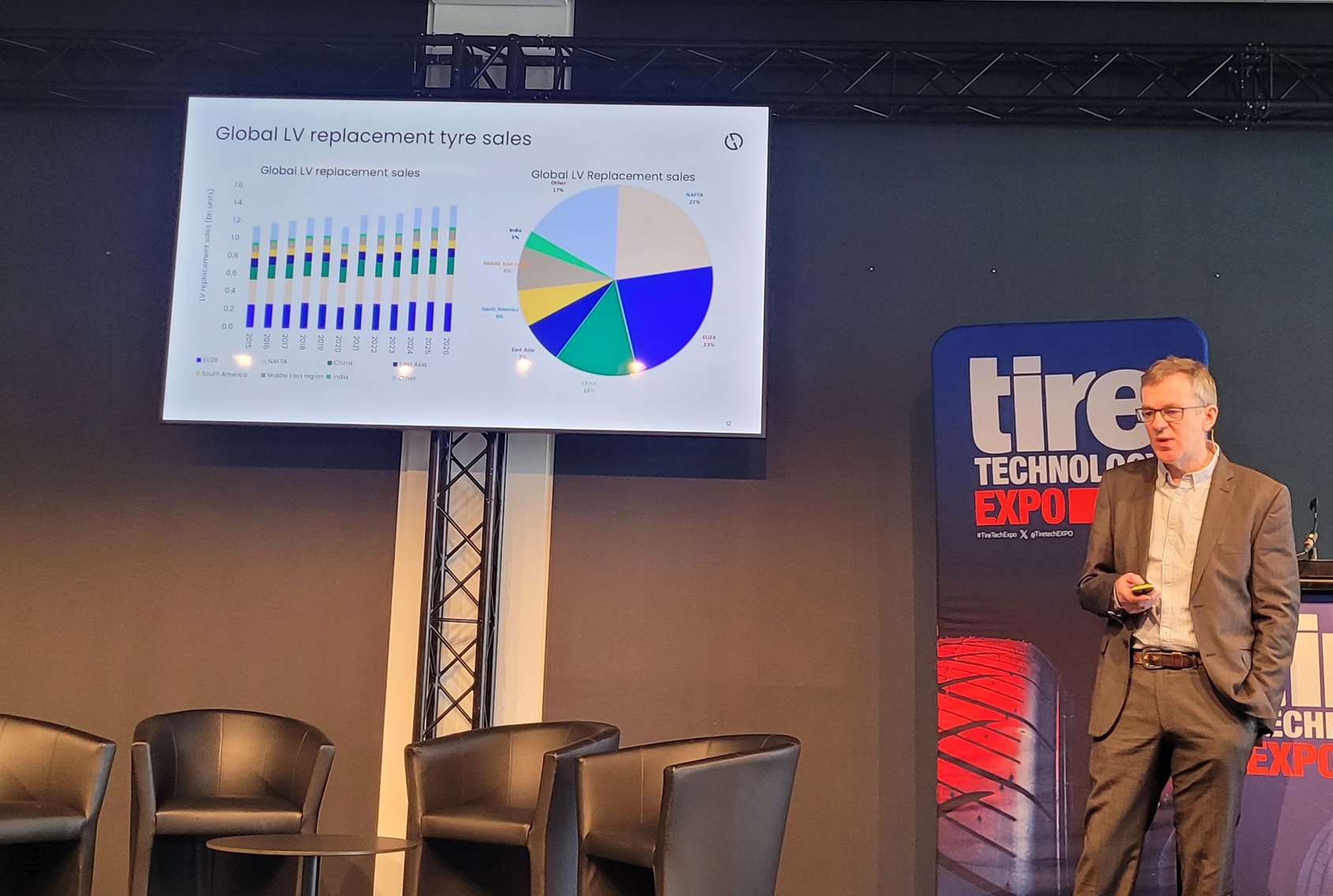
“The traditional vehicle-owning markets such as Europe, the US, Japan and Korea now account for only about half of global replacement tire sales,” he noted.
The other half, Simmons, said, is increasingly coming from emerging markets.
The "axis of the tire industry", Simmons concluded, is shifting towards emerging markets, where vehicle ownership and sales are growing rapidly.