
ERJ Brainteaser - January
30 Jan 2026
Our first award of 2026 goes to everyone who answered Q4: the new joint holders of the industry-leading Brainiac of the Month title



Question 4: Family affair
A father, mother and their two children are crossing a river. Their boat can only take one adult or two children at a time. What is the minimum number of journeys needed to take the family of four across the river?
Answer: Some impressive solutions (see below) from: Amparo Botella, responsable de Compras y Calidad, Ismael Quesada SA, Elche, Alicante, Spain; Kamila Staszewska, R&D / quality lead, Abcon Industrial Products Ltd, Cootehill, Co. Cavan, Ireland; John Bowen, BSc [Hons], CEng, MIMMM, consultant, Bromsgrove, UK; Hans-Bernd Luechtefeld, Consultant, Germany; Bharat B Sharma, technical director TWC Group (Techno Waxchem & Rajsha Chemicals), Kolkata, India; Andrew Knox, Rubbond International, Ohé en Laak, The Netherlands; Dr Kate Burns, senior technologist and regulatory officer, Prisma Colour Ltd, Birch Vale, High Peak, Derbyshire, UK; John Woods, materials technology consultant, Hanau, Germany; Andy Longdon, technical sales manager, Ceetak Ltd, Bedford UK; David Mann, polymer business development consultant, UK. Well done to all and everyone else who had a go.
SOLUTIONS
Amparo Botella
Nine crossings:
The two children cross together, one stays
One comes back with the boat
The mother goes alone
The child who stayed comes with the boat
The two children go again together
One of them returns with the boat
The father goes alone
The other child comes back
The two children go with the father and mother.
STAR ANSWER: Kamila Staszewska
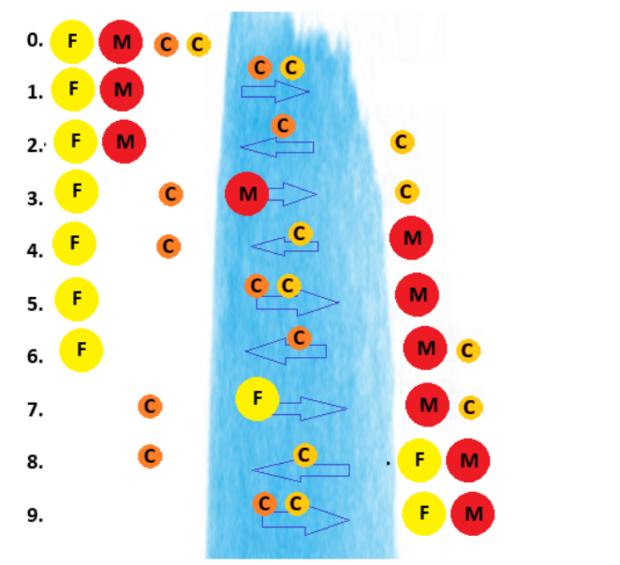
(Neat graphic - see above)
It will take 9 journeys as presented in the schematic.
Very busy trip for the children as they have to return the boat every time somebody is crossing!
John Bowen
We must assume that no ropes etc are used to pull the boat back and forth across the river,
A minimum of 9 one-way journeys (or 5 across and 4 back) are required to get the mother, father, and two children across, assuming the boat requires at least one person to row and we assume as above. The method involves the children repeatedly ferrying the boat back and forth to allow adults to cross individually.
Steps (9 total trips):
Children cross: Child A + Child B go across (1 trip)
Child returns: Child A comes back (1 trip)
Adult crosses: Adult 1 goes across (1 trip)
Child returns: Child B comes back (1 trip)
Children cross: Child A + Child B go across (1 trip)
Child returns: Child A comes back (1 trip)
Adult crosses: Adult 2 goes across (1 trip)
Child returns: Child B comes back (1 trip)
Children cross: Child A + Child B go across 1 trip)
Hans-Bernd Luechtefeld
9 journeys are needed:
Children cross: Both children go to the other side (1).
Child returns: One child brings the boat back (2).
Adult crosses: Father crosses alone (3).
Child returns: The other child brings the boat back (4).
Children cross: Both children go to the other side (5).
Child returns: One child brings the boat back (6).
Adult crosses: Mother crosses alone (7).
Child returns: The other child brings the boat back (8).
Children cross: Both children cross to the other side (9).
Bharat B Sharma
Condition-
Boat can only take one adult or two children at a time.
There will be 9 Trips Involved
Let’s name them as F (father) M(Mother C1(child 1) C2 (Child 2)
1.C1+C2 ? crossing
2.C2 ? crossing back
3 D ? crossing
4 C1 ? crossing
Now it's: C1+C2+M on one side.
So:
- C1+C2 ? crossing
- C2 ? crossing back
7 Mom ? crossing
8 C1 ? crossing back
9 C1+C2 ? crossing
TOTAL TRIPS INVOLVED 9.
Andrew Knox
Answer: 9 crossing
Crossings needed are:
- Both children cross together
- One child goes back
- One adult crosses
- Other child goes back
- Both children cross together
- One child goes back
- The other adult crosses
- The other child goes back
- Both children cross together
Kate Burns
STAR ANSWER
(Nice & concise)
Nine journeys are required to get the family across the river.
Both children cross
One child returns
First Adult crosses
Second child returns
5-8. Repeat 1-4 to get second adult across.
John Woods
Two scenarios are possible, the boat can return from the opposing bank without a person to pilot/ row the boat ( witnessed in Albania in 1989 where one man who stayed on the riverbank used a system of ropes to send and return the boat from the opposing bank to his side.
If this was the case, it would take 5 trips for the family to all cross the river:
Trip 1: Dad crosses over to the other side
Trip 2: Boat returns empty to opposing bank
Trip 3: Children cross to join Dad
Trip 4: Boat returns empty
Trip 5: Mum goes from to join Dad and their children
-> the family is reunited on the other side of the river.
Such a scenario seems improbable.
Start with: Mum, Dad, Child, Child
So:
Trip 1: Child+Child? cross
Trip 2 : one Child? crosses back
Trip3 : Dad? crosses
Trip 4 : the second Child? crosses back
That leaves: Child, Child, Mum at the starting point.
So:
Trip 5: Child+Child? cross
Trip 6: one Child? crosses back
Trip 7: Mum? crosses
Trip 8: second Child crosses back
Trip9 : the two children cross over
-> the Family are reunited on the other side of the river
Conclusion: 9 crossings are necessary in this much more probable scenario.
Andy Longdon
Trip 1: Child 1 and Child 2 to other side, leaving both parents behind
Trip 2: Child 1 returns, leaving Child 2 on far bank
Trip 3: Parent 1 crosses alone
Trip 4: Child 2 returns
Trip 5: Both children cross, leaving Parent 2 on near bank
Trip 6: Child 1 returns
Trip 7: Parent 2 crosses alone, leaving Child 1 on near bank
Trip 8: Child 2 returns, collects Child 1 and ....
Trip 9: Both children cross
Alternative, 5 trips, if they have a long enough rope to tie to the boat and hold on to at the near bank ....
Trip 1: Parent 1 crosses
Trip 2: boat is pulled back empty
Trip 3: Both children cross
Trip 4: boat is pulled back empty
Trip 5: Parent 2 crosses
Advantage of this option is that the children are never left unattended on either bank.
David Mann
STAR ANSWER
(Top table)
ff we call the family F, M, 1 and 2, and the river banks left and right,
|
Move |
In the boat |
Direction |
On Left Bank |
On Right Bank |
|
Start |
|
|
F,M,1,2 |
|
|
1 |
1,2 |
L to R |
F,M |
1,2 |
|
2 |
1 |
R to L |
F,M,1 |
2 |
|
3 |
F |
L to R |
M,1 |
F,2 |
|
4 |
2 |
R to L |
M,1,2 |
F |
|
5 |
1,2 |
L to R |
M |
F,1,2 |
|
6 |
1 |
R to L |
M,1 |
F,2 |
|
7 |
M |
L to R |
1 |
F,M,2 |
|
8 |
2 |
R to L |
1,2 |
F,M |
|
9 |
1,2 |
L to R |
|
F,M,1,2 |
So, 9 moves.
New teaser on Monday
Question 3: Snookered
Last week’s World Masters snooker tournament in London included a highly unusual run of results in the round-of-16 (see below), with each match won by a score of six frames to two. What was the probability of that happening?
Email your answer: correct replies on Friday.
Snooker Masters Round of 16
Judd Trump (England) beat Ding Junhui (China), 6 points to 2 points
Neil Robertson (Australia) beat Chris Wakelin (England), 6 points to 2 points
Kyren Wilson (England) beat Si Jiahui (China), 6 points to 2 points
John Higgins (Scotland) beat Barry Hawkins (England), 6 points to 2 points
Mark Allen (Northern Ireland) beat Mark Williams (Wales), 6 points to 2 points
Zhao Xintong (China) beat Gary Wilson (England), 6 points to 2 points
Wu Yize (China) beat Shaun Murphy (England), 6 points to 2 points
Xiao Guodong (China) beat Mark Selby (England), 6 points to 2 points.
Answer: On the ball this week were a highly select group of Brainiacs: estimating probabilities ranging from 220,000 to 490 million to one – depending on interpretation, source, etc. Very well done to: David Mann, polymer business development consultant, UK; Kamila Staszewska, R&D / quality lead, Abcon Industrial Products Ltd, Cootehill, Co. Cavan, Ireland; Andrew Knox, Rubbond International, Ohé en Laak, The Netherlands; John Bowen, BSc [Hons], CEng, MIMMM, consultant, Bromsgrove, UK; John Woods, materials technology consultant, Hanau, Germany; and everyone else who had a go.
SOLUTIONS
STAR ANSWER: David Mann
(See charts attached above - below main image)
Interesting question!
Most statistics questions have assumptions about randomness, which is probably less likely in snooker than other situations, due to varying skill levels and the pernicious influence of betting.
Nevertheless, I approached this assuming every frame was 50/50, the match was over once any player reached 6, and the first frame had to result in a score of 1-0.
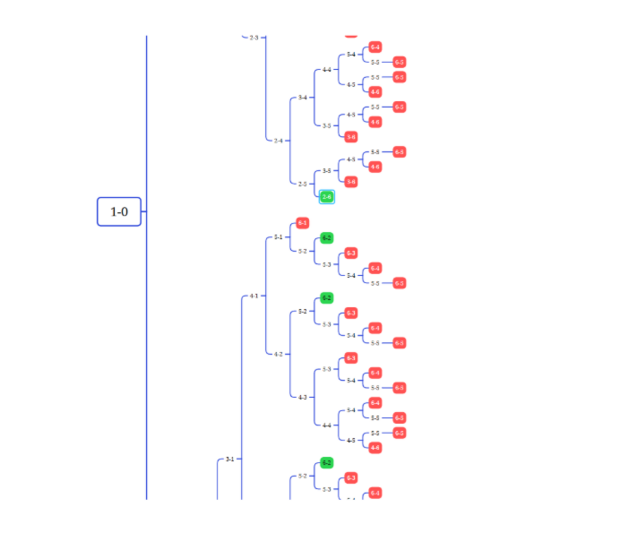
I’m sure there’s an elegant statistical method for what I did, but I built an all outcomes model using Xmind. Partial views below.
When the chart was complete I coloured 6-2 or 2-6 results in green and any other in red.
Result was 18 6-2 and 296 others, so 6-2 would happen at a probability of 0.0573 per match. But for 8 matches it is 0.0573 to the power of 8, a minuscule probability of 1.16612E-10. If someone had a bet on that, they’d be very rich now!
Kamila Staszewska
The match ends when someone reaches 6. 6+2=8 frames played.
W = winner
L = loser
In first 7 frames W wins 5 times and L wins 2 times (in any order).W is winning 8th frame (only one possibility).
Probability of 6-2 result:
P=*(1/2)^8=(7*6)/2*1/(2^8)=21/256(~8.2% or 1 chance in 12.2 matches)
Probability all 8 matches finish 6-2:
P=(21/256)*(21/256)*(21/256)*(21/256)*(21/256)*(21/256)*(21/256)*(21/256)=(21/256)^8=2.050381314*10^-9
1/2.050381314*10^-9= 1 chance in ~487.7 million
Andrew Knox
Answer: (21/256)power8 or roughly 1 in 490 million.
Reasoning: In the London World Masters there were 16 players so 8 matches in the first round which were all the best of 11 frames. To win 6:2 the score first has to reach 5-2 and then the final frame needs to be won by the player who leads with the score 5-2.
There are 256 possible outcomes for each match ((1/2) power8) and 21 ways to reach the result of 5-2.
So, the chance of all 8 matches in the first round ending up with a score of 6-2 is (21/256) power 8 = ca. 2.044 x 10 power -9 or 0.000000002044.
John Bowen
All eight first-round matches ended in 6–2 scorelines, the odds of which were estimated at 220,000 to 1 according to several sources.
John Woods
Calculate the probability assuming that ,
- each match is the best of 11 frames
- and consequently the first player to win 6 frames is declared the winner
- each player is of equal ability i.e. Ronnie O’ Sullivan is not playing against someone of my level of feeble ability : 6-0 would be the only outcome during each of the 8 matches.
Whereas the following 6 outcomes is possible for each match ,
6-0 , 6-1 , 6-2 , 6-3 , 6-4 and 6-5
For one match, the probability of 6-2 is
1 in 6
For eight matches therefore the probability is 1 chance in 6^8 or 1 chance in 1679616 or 0,0000595374 %. I am not a betting man, but it would be foolish to place money on such a low probability.
New teaser on Monday.
Question 2: Give me five II
Write a mathematical expression that has the value of exactly 5, using:
Two, and only two, 2s, and
Any mathematical symbols or operation.
Answer: Very well done for the great solutions (see below) from: Andy Longdon, technical sales manager, Ceetak Ltd, Bedford UK; John Bowen, BSc [Hons], CEng, MIMMM, consultant, Bromsgrove, UK; Andrew Knox, Rubbond International, Ohé en Laak, The Netherlands; Amparo Botella, responsable de Compras y Calidad, Ismael Quesada SA, Elche, Alicante, Spain; Kamila Staszewska, R&D / quality lead, Abcon Industrial Products Ltd, Cootehill, Co. Cavan, Ireland; Sudi Sudarshan, principal consultant, Global Mobility Strategies, USA; John Woods, materials technology consultant, Hanau, Germany; and everyone else who had a go.
Please note: To make things even more interesting, we have introduced ‘Star Answer’ to recognise extra interesting replies from readers. There will some extra points going for this, which will help us in selecting the winners of the prestigious Brainiac of the Month and Brainiac of the Year awards.
SOLUTIONS
STAR ANSWER: John Woods
I was tempted to say that it is obvious if I was inspired by The Big Brother control of thoughts in the George Orwell classic ‘1984’. The central character Winston Smith is informed after his arrest that control over physical reality is unimportant to the Party provided that the citizens of Oceania subordinate their real-world perceptions to the political will of the Party who could dictate that 2 + 2 = 5.
More mathematically, my proposal is:
[ sec arctan 2 ] to the power of 2 = 5
Where arctan is the angle of a right triangle and and secant is the hypotenuse over the adjacent ( I tip my cap to Pythagoreus ).
Andy Longdon
T2 + 2 = 5
Where T is the Triangular Number, equivalent to : Tn = {n(n+1)}/n When n = 2, T2 = {2 * (2 + 1) } / 2 = 3 Add the second 2 and the answer is 5.
Or using the “termial” function notation: n? = 1 + …. + n The additive version of the more common n! factorial operation.
2? + 2 = 5 2? = 1 + 2 = 3 Add the second 2 and the answer is 5.
John Bowen
5 can be achieved using the function T2, which is the Triangulat function of 2. This is a bit similar to Factorial but instead of multiplying we add, so T2 = 1 + 2 =3 so we now have
T2 + 2 = 5
QED
Andrew Knox
I don't know how to write the symbol here for Factorial 2, but I believe (Factorial 2) + 2 could = 5, as the factors of 2 are 1 & 2. Does 1 & 2 = 3? I guess so.
Amparo Botella
Maybe the most closed to 5 can be = 2π-√2≈5.
Kamila Staszewska
The number five is obtained by adding two squared and two to the power of zero.
Sudi Sudarshan
The only thing I could come up with is this:
?22?= 5 (ceiling or round up function).
Question 1: Next numbers
10/4 = 100
30/5 = 150
19/7 = 200
?/? = ?
Answer: Happy New Year to all our readers and a big well done to everyone who got off on the right track with 7/9 = 250 (See solutions below): Andy Longdon, technical sales manager, Ceetak Ltd, Bedford UK; John Coleman, membership manager, Circol ELT, Dublin, Ireland; Kamila Staszewska, R&D / quality lead, Abcon Industrial Products Ltd, Cootehill, Co. Cavan, Ireland; Dr Kate Burns, senior technologist and regulatory officer, Prisma Colour Ltd, Birch Vale, High Peak, Derbyshire, UK; John Woods, materials chemistry and technology consultant, Hanau, Germany; Amparo Botella, responsable de Compras y Calidad, Ismael Quesada SA, Elche, Alicante, Spain; David Mann, polymer business development consultant, UK; Sudi Sudarshan, principal consultant, Global Mobility Strategies, USA; and everyone else who had a go.
SOLUTIONS
Andy Longdon
Sequence is number of days inclusive from 1st January 2026 until date (eg 10th April, 30th May etc), increasing in 50’s. So next in the sequence, 250 days from 1st Jan, would be 7th September (7/9).
10/4 = 100
30/5 = 150
19/7 = 200
7/9 = 250
John Coleman
These all refer to dates and the number of days between them.
Therefore, taking an additional 50 days as per the sequence and applying the relevant date would give 7/9 = 250.
Kamila Staszewska
The question is related to the New Year as well - since 2026 is a common year (not a leap year), the following applies to it:
10/04 is 100th day of the year.
30/05 is 150th day of the year.
19/07 is 200th of the year
The answer is 07/09 which is 250th day of the year
Dr Kate Burns
The numbers are dates and the day of the year, i.e. 10th April (10/4) is the 100th day of the year, 30th May is the 150th day and so on. 7th September is the 250th day of the year, so 7/9=250.
John Woods
The next numbers are 7/9 and 250.
The preceding numbers are the calendar dates corresponding to the 100th , 150th and 200th day of a year ( leap years excepted ). The 7th of September ( 7/9 ) is the 250th day of the year.
Amparo Botella
I got illuminated just now, thinking of a date instead of a number.
So, the reply will be days on the stated date:
April 10th. is the day 100 of the calendar on a non leap year
May 30th. is the day 150 of the calendar on a non leap year
July 19th. is the day 200 of the calendar on a non leap year
Now we're looking for the 250th day of the year.
That brings us to September 7th.
So the solution to this teaser is:
7/9 = 250
David Mann (Welcome back!)
I think these are day numbers so 7/9 = 250
Sudi Sudarshan
My answer to this week's brainteaser:
7/9 = 250
Left hand side numbers are dates in a non-leap year and right hand numbers are the number of days elapsed from the beginning of the year up to and including that date in a non-leap year.
10/4 or April 10th is the 100th day, 30/5 or May 30th the 150th day, 19/7 or July 19th the 200th day and 7/9 or September 7th the 250th day of the year!
