Tyres Europe wants urgent action on competitiveness, regulation
10 Dec 2025
Share:
McCarthy sets out key priorities amid mounting cost and regulatory pressures on EU tire makers
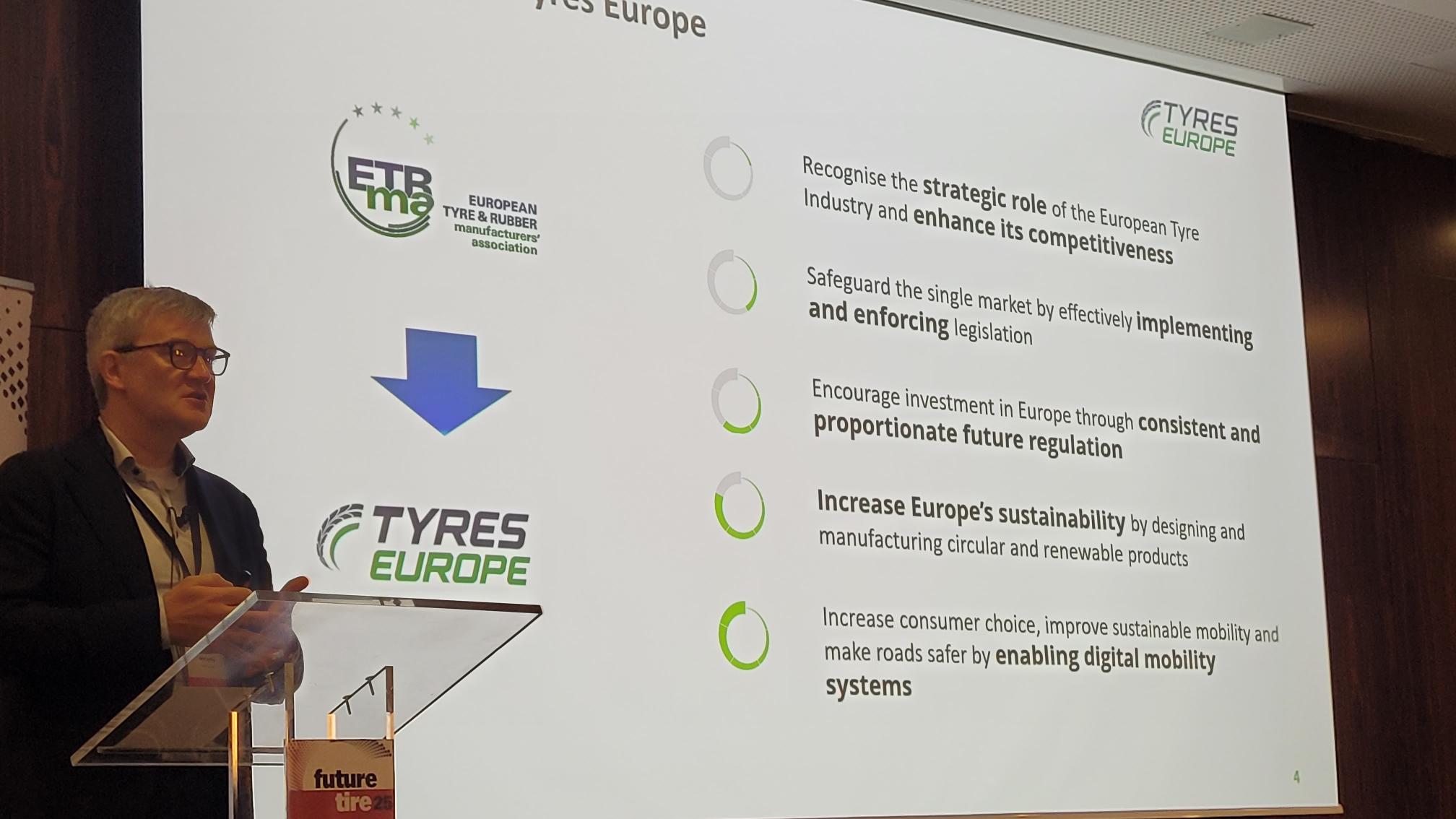
Prague – Tyres Europe* has warned that the cost of making tires in the EU could become “more or less unsustainable” without urgent regulatory support for the region’s production base.
At the Future Tire Conference 2025 in Prague, secretary general Adam McCarthy said the EU industry is facing soaring input costs while competing with significantly lower-cost imports.
In recent years, the cost of production – both in terms of energy and labour – has become "more or less unsustainable,” according to the Tyres Europe leader.
“Roughly 40% of the market is now imported from other parts of the world, particularly from China and other Asian geographies,” he added at the 18-19 Nov conference.
Citing estimates by Tyres Europe, McCarthy said that in 2019 it cost €134 to produce a tire in Europe, compared to €127 in the US and €100 in Asia.
Today, he said, it costs nearly €191 to produce a passenger-car tire in Europe, compared to €176 in the US, while the cost in Asia has remained "more or less the same.”
Measures to reduce production costs
Setting out two core demands for policymakers to help address the situation, McCarthy described EU tire manufacturing as "a strategic industry that does need help, that does need support.”
In particular, he said Tyres Europe aims to ensure that transition to a low-carbon economy "not only regulates the industry; it also protects production capacity.”
This means that the tire industry will have the ability to access support mechanisms, for example for the electrification of the production process.
The second priority concerns the Carbon Border Adjustment Mechanism (CBAM), which McCarthy described as “a border tax placed on products coming from jurisdictions where they do not have a cost-per-tonne of carbon emitted.”
“This has significant impact on the cost of production here in Europe,” he warned.
“When CBAM is implemented next year, the only part of the tire so far included is steel cord,” he said.
However, according to McCarthy, an “extension” is likely to be introduced, which could include other tire materials such as carbon black and inorganic chemicals.
Simplifying regulation
Tyres Europe is also calling on EU lawmakers to simplify the regulatory landscape for the sector.
As McCarthy pointed, with the upcoming automotive omnibus package - scheduled for 10 Dec - acro.ss a number of areas "there is clear need for simplification.”
“We need to make sure regulation is well thought through, consistent, and that the impact on the industry is understood,” he added.
Meanwhile, tires have been listed as a "priority product,” under the European Commission’s (EC) draft Ecodesign for Sustainable Products Regulation (ESPR).
Here, the Tyres Europe leader urged that industry-wide definitions should be included in the legislation.
“For example: what is actually the definition of a 'tire' [within] the secondary legislation; questions around remanufacturing versus refurbishment; is a retreaded tire, a re-manufactured [or] a refurbished product?”
With a proposal likely by end of 2027, said McCarthy: "We need to ensure that all of the items being placed on the European market are following the rules.
"Therefore, we need market surveillance, because otherwise you are creating complexity that perhaps not everyone is following.”
Heavy-duty vehicle rules
Furthers challenges facing the tire sector stem from the heavy-duty vehicle CO2 emissions regulation, where the EC is proposing 'in-service verification' for trucks.
“For a tire, because a tire degrades over time, they have decided it will be checked at the beginning of life,” according to McCarthy.
That, he said, introduces an extra layer of requirement: "We already have type approval, conformity of production and market surveillance, yet we may still fail the in-service verification due to a different test method.”
“So, we are having double-regulation… which has no real impact on the goal of the legislation,” said McCarthy.
Tyres Europe is, therefore, proposing that the Commission “simply takes tires out of the heavy-duty vehicle regulation, because it makes no sense.”
Euro 7: two-year delay?
On Euro 7, McCarthy said Tyres Europe is recommending a two-year extension for C3 truck and bus tires, recognising “the complexity of developing a test method, then using that method to understand how much material is abraded, and then using that data to set meaningful emission limits.”
Under the UN process, limits must be agreed by April 2030; failing that, the Commission can proceed alone by 2031.
The tire industry, McCarthy said, prefers the UN route, which offers “a more global approach. We’re suggesting moving everything two years forward.
Moving the target from 2032 to 2034, for instance, would result in “a more efficient and realistic threshold actually based on data.”
New regulatory agenda: data access and digital services
McCarthy closed his presentation with a review of the broader regulatory agenda, which he described as “fast-changing.”
For example, he highlighted the need to apply the EU Data Act appropriately to ensure the tire industry gains consistent access to in-vehicle data.
Such access, he said, would "enable tire-related digital services that support road safety and environmental performance.”
It would also ensure that tire makers are “not knocked out” by the car makers and will ultimately open up new business models for the industry.
*Formerly the European Tyre & Rubber Manufacturers' Association (ETRMA)
This article is only available to subscribers - subscribe today
Subscribe for unlimited access. A subscription to European Rubber Journal includes:
Every issue of European Rubber Journal (6 issues) including Special Reports & Maps.
Unlimited access to ERJ articles online
Daily email newsletter – the latest news direct to your inbox