Bridgestone develops ‘room temp’ chemical recycling of tires
10 Dec 2025
Share:
Project with AIST involves two-stage chemical recycling of vulcanised tire rubber into isoprene monomer and carbon black
Tokyo – Bridgestone and Japan’s National Institute of Advanced Industrial Science and Technology (AIST) have developed a two-stage chemical-recycling process that can break down vulcanised tire rubber at room temperature.
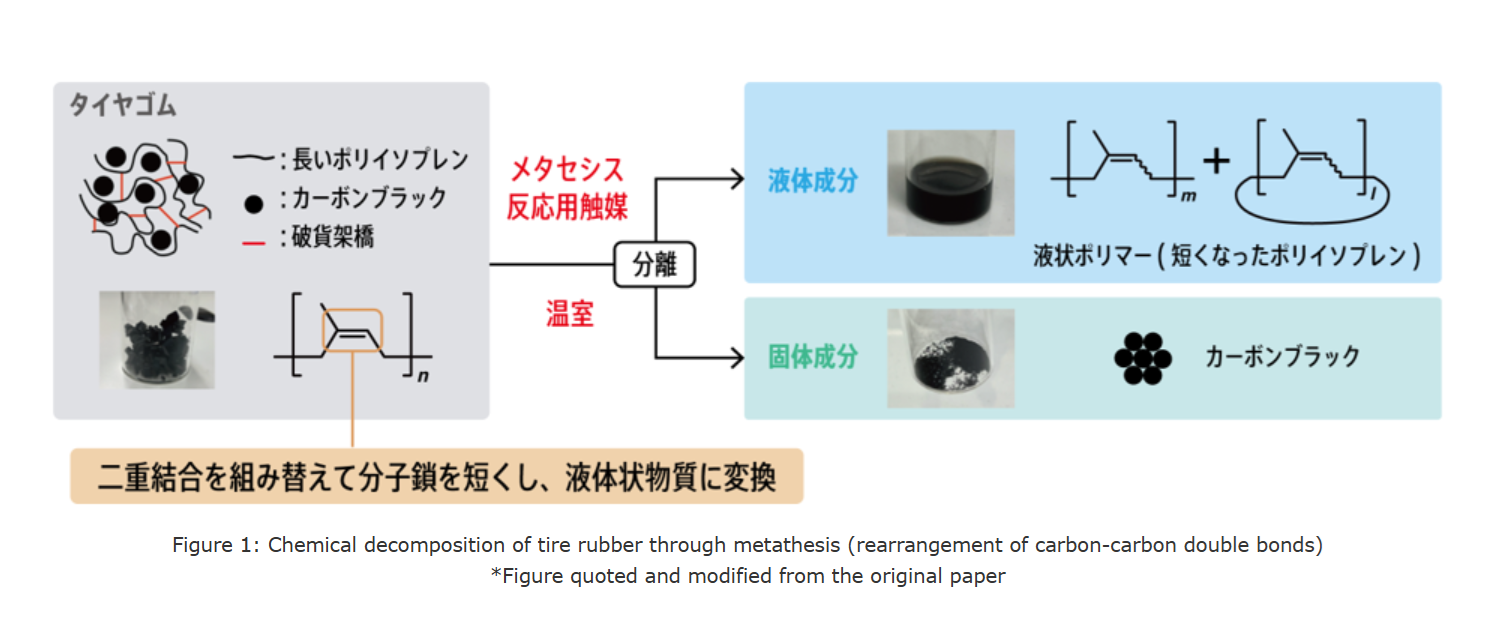
Announcing the results on 4 Dec, the partners said the newly developed technology “rearranges” carbon-carbon double bonds, chemically decomposing vulcanised polyisoprene using a “metathesis reaction”, followed by thermal decomposition.
The process yields isoprene and carbon black as well as BTX (benzene, toluene, xylene) as chemical feedstocks.
While polyisoprene, including natural rubber, is reportedly easy to decompose using catalytic metathesis, Bridgestone said vulcanised polyisoprene rubber in used tires is difficult to decompose.
This, it said, is due to the sulphur components which inhibit the metathesis decomposition reaction.
According to the researchers, selecting the “appropriate catalyst” and solvent for tire rubber enables the crosslinked polyisoprene to undergo chemical decomposition under "mild conditions near room temperature."
Explaining the process, Bridgestone said when an intermolecular metathesis reaction occurs, carbon-carbon double bonds are rearranged between polyisoprenes.
But the resulting polyisoprene molecular chains range from short to long, making it impossible to obtain only short molecular chains.
For this reason, the research focused on chemical degradation of polyisoprene via “intermolecular metathesis” between polyisoprene and low-molecular-weight reactants containing carbon-carbon double bonds.
On the other hand, Bridgestone said, when an intramolecular metathesis reaction of polyisoprene occurs, cyclic polyisoprene is produced, shortening the polyisoprene molecular chain.
In this study, the partners said they “experimentally confirmed” that adding an appropriate catalyst and solvent to vulcanised polyisoprene rubber “significantly shortens the polyisoprene molecular chain within a few hours at room temperature.”
To clarify this mechanism, they performed detailed structural analysis of the reaction product and found that the main component of the liquid polymer is “a cyclic compound centred on cyclic isoprene tetramers.”
Furthermore, by isolating and purifying the cyclic isoprene tetramer and performing single-crystal X-ray structural analysis, the researchers said they elucidated "the molecular structure [of cyclic isoprene tetramer], including the three-dimensional structure, for the first time.”
When the resulting liquid polymer was subjected to thermal decomposition, isoprene appeared as the major product, Bridgestone said.
AIST and Bridgestone said the findings establish a scientific basis for chemical recycling of end-of-life tires, addressing a long-standing challenge due to the complex, sulphur-crosslinked structure of vulcanised rubber.
The partners plan to expand the technology to other rubbers such as butadiene rubber and to explore applications for the newly isolated cyclic isoprene tetramer, while also examining scale-up toward commercialisation in the 2030s.
This article is only available to subscribers - subscribe today
Subscribe for unlimited access. A subscription to European Rubber Journal includes:
Every issue of European Rubber Journal (6 issues) including Special Reports & Maps.
Unlimited access to ERJ articles online
Daily email newsletter – the latest news direct to your inbox