Cefic reports lower output, falling exports and rising imports in first eight months of 2025
Brussels – Europe’s chemical industry continues to struggle against weak demand, high energy prices and growing competitive pressure from China, according to the latest EU chemical trends report published 28 Nov by Cefic.
Cefic described the situation as “worrying”, noting that companies face a very difficult global economic context while energy costs in Europe remain among the highest in the world.
The sector, it said, is also suffering from fierce global competition and an “open market” combined with “an unmatched level of regulation” that has reached its limits.
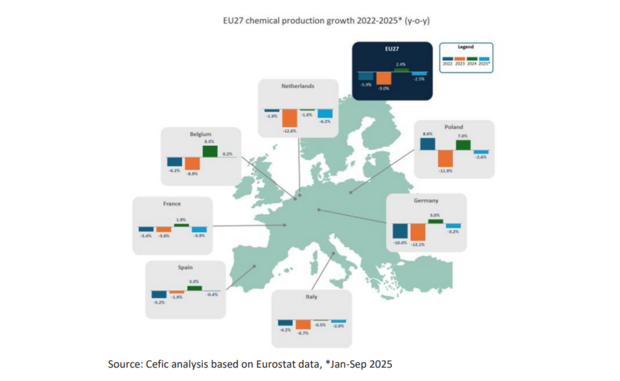
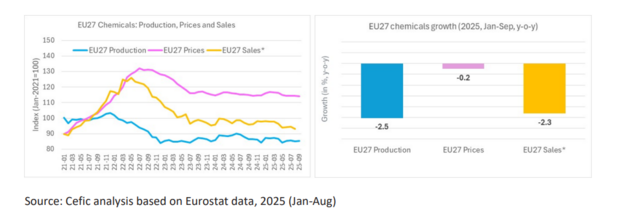
Over the first nine months of the year, chemical production in the EU27 was down 2.5% year-on-year with performance of member states varying sharply during the period.
The Netherlands reported a 6.2% decline in production for the nine-month period, while France, Germany and Italy were down 3.9%, 3.2% and 2.0% respectively.
Spain saw a drop of under 1%, while Belgium posted a slight 0.2% increase and Poland declined 2.6%.
Cefic said the fragmented picture reflects an “uncertain” economic backdrop, predicting a decline of “more than 2%” in chemicals output in 2025, compared with 2.4% growth a year earlier.
According to the European organisation, the chemical industry output remains 10% below the pre-crisis levels of 2014 to 2019.
“Unfortunately, no strong positive changes have been observed so far this year and business expectations for most downstream users are still not encouraging,” it added.
On the demand side, Cefic said “most downstream users of chemicals” reported a decline in output, despite a general 1.4% year-on-year growth in the manufacturing sector.
For instance, Cefic said, the automotive sector is still experiencing a significant decline of about 3.4%.
Chemical exports from the EU27 fell 2.3% year-on-year in value terms during the first eight months of 2025, while imports rose 2.6% over the same period.
Cefic warned that persistent uncertainty is holding back investment and that the number of chemical-plant closures is contributing to “deindustrialisation, to the benefit of countries offering a cost advantage”.
Extra-EU chemical trade “continued to deteriorate,” said Cefic.
In the first eight months of 2025, EU27 chemical exports totalled €148.6 billion, down €3.5 billion year-on-year.
The US remained the largest destination (€28.3 billion), followed by the UK (€17.0 billion) and China (€11.6 billion).
Speciality chemicals made up the largest share of exports (€49.8 billion), followed by petrochemicals (€33.1 billion) and consumer chemicals (€25.4 billion).
Export volumes also dropped, with shipments reaching 61.3 kilotonnes in the first eight months of the year, down from 62.8 kilotonnes in 2024.
The UK was the largest export destination by volume at 8.5 kilotonnes, ahead of the US (5.6 kilotonnes) and Turkey (4.1 kilotonnes).
Chemical imports, on the other hand, continued to rise.
According to Cefic, in the first eight months of the year, import values reached €123.7 billion, up 2.6% year-on-year.
China was the largest importer (€22.2 billion), followed by the US (€20.9 billion) and the UK (€12.7 billion).
Petrochemicals dominated import values (€48.1 billion), with speciality chemicals (€29.3 billion) and polymers (€21.0 billion) following.
Import volumes also increased 5.2% year-on-year to 69.1 kilotonnes, compared with 65.6 kilotonnes a year earlier.
The US was the biggest source by volume with 10.1 kilotonnes, ahead of China (6.7 kilotonnes) and the UK (6.3 kilotonnes).