Wevo launches LSR systems for textile coatings, sealing applications
23 Jan 2026
Share:
Materials enable “precise and automated manufacturing processes” using dispensing on textiles, plastics and metals.
Ostfildern-Kemnat, Germany. Wevo-Chemie GmbH has recently introduced two new liquid silicone rubbers (LSRs) specially developed for silicone textile coatings and sealing applications.
Wevosil 23010 and Wevosil 23030 combine “excellent processability with high elasticity, temperature resistance and adhesion,” according to a Wevo press release 19 Nov.
The new LSRs enable “precise and automated manufacturing processes” using dispensing on textiles, plastics and metals.
The materials offer an operating temperature range from -60 to +200 °C and are claimed to demonstrate “excellent behaviour” in thermal shock tests, Wevo said.
Wevosil 23010 is a self-adhesive, 'extra-soft' LSR for textiles with Shore A 10.
It offers an elongation at break of over 900% and a tensile strength of 5.5 N/mm2 as well as good “initial adhesion” on textiles or polymer surfaces without the need for primers.
The material is suitable, for example, as a silicone textile coating to reinforce technical textiles. It can also be used for permanently bonding textile layers and embedded electronics.
It can also be used in the manufacture of smart textiles, such as protective clothing for firefighters or military applications as well as sportswear with extended functionalities.
Wevosil 23030 is billed as a 'classic' LSR for fuel cells and electronics with Shore A 30, offering slightly higher strength and good mechanical properties.
The material provides an elongation at break of over 500% and a tensile strength of 5.0 N/mm2.
After post-curing, it exhibits good adhesion to substrates such as metals and plastics, making it particularly suitable for applications with demanding requirements in terms of long-term stability and temperature resistance.
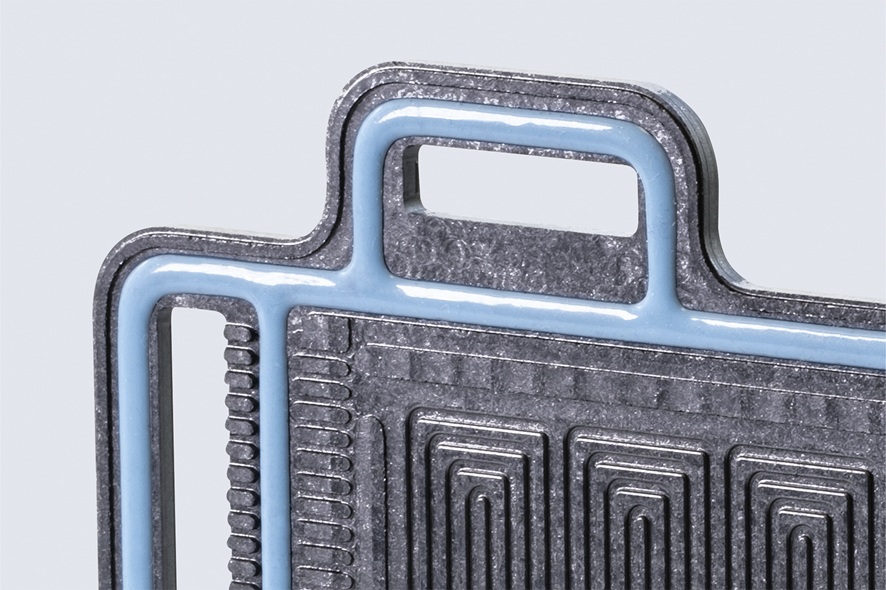
Furthermore, Wevo said the ‘dispensing’ options enables the use of the LSRs in sealing as ‘cured- or formed-in-place gaskets’ in stacks and bipolar plates for fuel cells and electrolysers.
Another target application area is for the attachment of electronic components to clothing for extended functionalities, the company noted.
This article is only available to subscribers - subscribe today
Subscribe for unlimited access. A subscription to European Rubber Journal includes:
Every issue of European Rubber Journal (6 issues) including Special Reports & Maps.
Unlimited access to ERJ articles online
Daily email newsletter – the latest news direct to your inbox