Smithers invests in advanced rolling resistance testing in China
3 Dec 2025
Share:
Company adds 'three capabilities' at Suzhou centre to provide ‘more comprehensive insight’ into tire performance
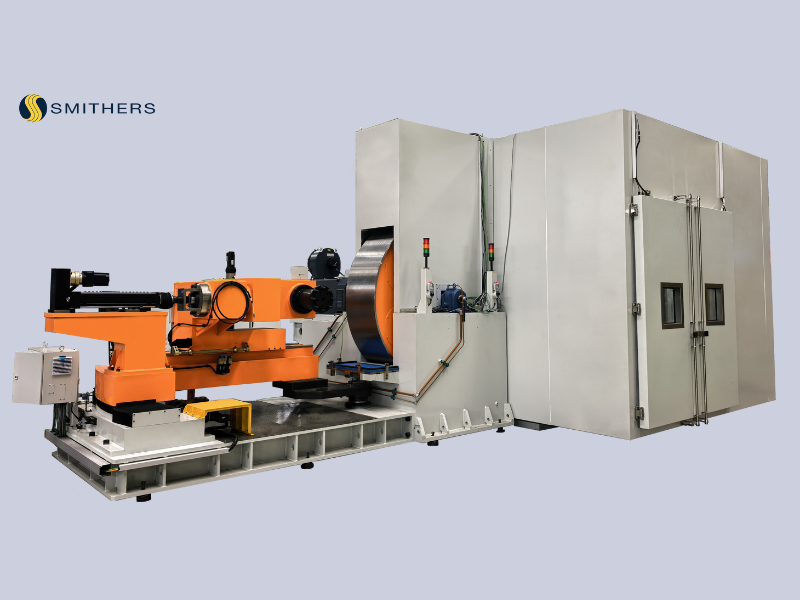
Akron, Ohio – Smithers has invested in new tire rolling resistance testing machinery at its tire and wheel testing centre in Suzhou, China.
The testing and compliance consulting firm said it has added “three specialised rolling resistance testing capabilities,” which can recreate a wider range of real-world situations at the Chinese centre.
This, said Smithers in a 20 Nov statement, will provide more comprehensive insight into vehicle operating scenarios.
The new machinery can test rolling resistance with slip/camber angle for passenger car and light truck (PC/LT) tires.
According to Smithers, traditional rolling resistance testing is conducted at 0° slip and camber angles.
However, factors such as wheel alignment, steering operations, and changes in vehicle body attitude can cause small changes to slip and camber angles during real-world driving conditions.
The new machinery simulates a wider range of slip and camber angle scenarios, providing automotive OEMs with deeper insight into vehicle energy loss due to wheel alignment parameters.
Additionally, tire manufacturers can evaluate the impact of angle parameters on rolling resistance and use the data to optimise tire structure and tread design, Smithers said.
Furthermore, the machinery can conduct high- and low-temperature rolling-resistance testing for truck and bus radial (TBR) tires.
Changes in rolling resistance are among the key factors affecting vehicle range in winter, but regulatory standards for rolling resistance are based on a “narrow temperature range,” said Smithers.
In response to client feedback, the firm invested in high- and low-temperature rolling resistance testing capabilities for PC/LT tires in 2022 and the new investment adds the ability to test a wider range of tires.
The equipment can also test rolling resistance of PC/LT tires with chassis components, such as half-shafts and brake discs, which can significantly affect vehicle range over the long term.
According to Smithers, there is a shortage of specialised indoor testing capabilities to independently measure such resistance.
Using a “proprietary new design,” Smithers said it can simultaneously mount chassis components during rolling resistance testing and obtain data on both tire-only resistance and the total resistance of the tire and chassis components.
The data is then used to calculate the resistance of chassis components, which OEMs can use to optimise vehicle energy loss.
All three capabilities are expected to be fully operational by 1 Dec.
“Smithers is seeing increased demand on a global scale for testing of tires and vehicles that more closely mimics real-world conditions,” said Derek Read, VP Asia Pacific/global development, materials science and engineering, Smithers.
The new capabilities, he noted, are investments into the “refined, scenario-based testing” required by clients and will help improve both tire and tire-chassis-vehicle system performance.
This article is only available to subscribers - subscribe today
Subscribe for unlimited access. A subscription to European Rubber Journal includes:
Every issue of European Rubber Journal (6 issues) including Special Reports & Maps.
Unlimited access to ERJ articles online
Daily email newsletter – the latest news direct to your inbox