Prague – Nexen Tire is advancing an AI-based virtual tire development process to reduce physical prototyping and shorten development cycles, according to chief technology officer Jong Myung (Brad) Kim.
In a 18 Nov keynote presentation at Future Tire Conference 2026, Kim outlined the Korean tire maker's approach to integrating AI while warning that growing reliance on artificial intelligence (AI) could undermine essential engineering expertise.
The Korean tire maker, said Kim, is using a combination of AI, finite element analysis (FEA), vehicle dynamics modelling and driving simulation to enhance its product development.
The objective, he explained, is to shift design iterations from physical prototypes to virtual environments, allowing engineers to evaluate a wider range of specifications before committing to actual tire production.
According to Kim, conventional OE tire development typically involves two to four physical prototype builds, with development taking around two to three years.
"We gain insights from every loop, but each round consumes valuable time and resources," Kim said, explaining that particularly demanding performance requirements could extend the process further.
Under the virtual development approach, engineers first use AI and FEA to compare, improve and screen tire designs before evaluating their compatibility with specific vehicles.
The process combines tire models with vehicle dynamics simulations, followed by driving simulator assessments in which test drivers evaluate subjective handling characteristics.
Kim said subjective driving feel "is still not easy to replace with AI," highlighting the continued importance of human evaluation.
"The goal is to reach our first physical prototype with a much clearer picture and get the most out of every test," he explained.
From thousands of designs to one specification
To illustrate the approach, Kim presented a hypothetical development programme beginning with 1,000 potential tire specifications.
Engineers would establish design requirements and constraints, allowing AI to screen the initial candidates and narrow the selection to around 100.
These would undergo FEA to examine tire performance, reducing the selection to approximately 10 specifications.
The remaining candidates would then be assessed through vehicle dynamics analysis and driving simulation before engineers could select a final design for physical validation.
The process is intended to account for competing tire characteristics, including steering response and ride comfort, rather than optimising individual properties in isolation.
Nexen, Kim stressed, is therefore seeking to incorporate vehicle dynamics assessment earlier in the development process, avoiding repeated redesigns after physical vehicle testing.
Furthermore, the Nexen CTO pointed to the importance of training AI tools using individual manufacturers' production and development data.
"If the AI model works in other companies, it doesn't guarantee that [it works] in your company," Kim said.
Changes in production conditions, including equipment parameters such as extruder speeds, could also affect model accuracy over time.
"You need to constantly update those data to refine your AI model," he added, describing the process as difficult and time-consuming but "really important".
Warning over loss of engineering expertise
Beyond technical development, Kim raised concerns about the longer-term implications of AI for tire engineering and research organisations.
He warned that increasingly capable AI systems could eventually take over large parts of tire design, leaving engineers implementing decisions without understanding the underlying technical rationale.
"People stay busy, but they no longer understand why AI has chosen a particular specification," he said, describing a possible future in which engineers become excessively dependent on automated decisions.
"When we stop thinking about options through the rationale, we lose the very experience that enables engineering judgment."
Kim said the industry needed to define the respective responsibilities of AI and human engineers before increasingly capable systems became embedded throughout development operations.
Under Kim's proposed two-tier model, AI would undertake routine groundwork, including data preparation, analysis, reporting and the generation of training materials.
Engineers would then use the outputs to evaluate alternatives, assess performance trade-offs and make final development decisions.
The aim, according to Kim, is to redirect time saved through automation towards "deeper cognitive work and higher level judgment."
'Maestro' model for future tire R&D
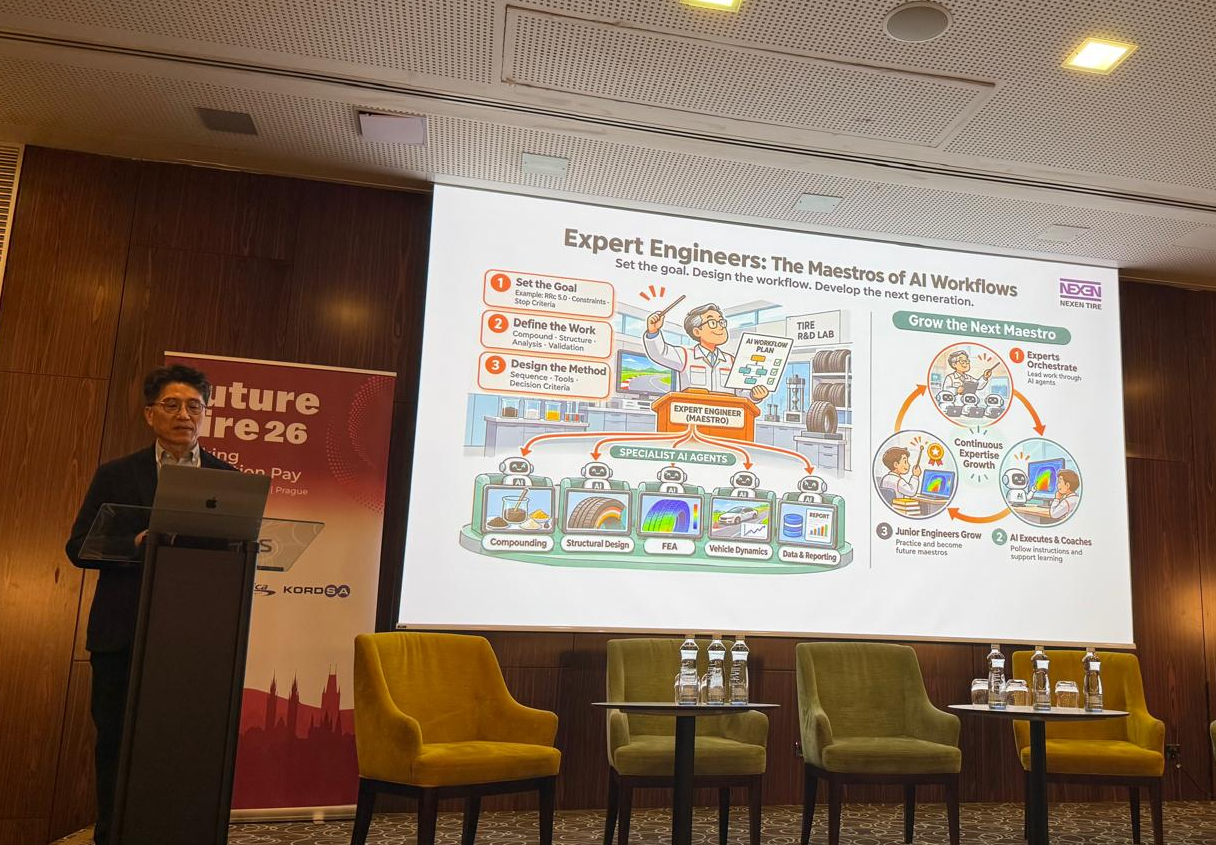
Kim also outlined his vision for the future of tire R&D organisations, in which experienced engineers would direct networks of specialised AI agents.
Under what he called the "Maestro" model, a senior engineer would define development objectives, determine the required workflows and coordinate AI systems responsible for various functions.
These, he said, could include compounding, structural design, FEA, vehicle dynamics and reporting.
The engineer would ensure consistency between the systems and retain responsibility for final technical decisions.
"For this model to function effectively, the missing puzzle piece isn't better AI, it's an experienced engineer," Kim said.
A further responsibility would be the training of junior engineers, who would learn to assess design alternatives and understand the reasoning behind technical decisions.
Kim envisaged a future transformation in the structure of tire R&D organisations, moving away from traditional management hierarchies towards a more collaborative "hub-and-spoke" model.
AI-supported systems would allow engineers and managers to access development information in real time, reducing reporting layers and improving coordination between traditionally separate teams.
The envisaged structure would also help overcome organisational "silos," he said, by providing shared access to project data and development progress.
Concluding his presentation, Kim emphasised that responsibility for tire development and engineering expertise should remain with people, regardless of technological advances.
"Technology will continue to advance exponentially," he said. "But the ultimate responsibility, which is building great tires and nurturing great engineers, should remain in our hands."