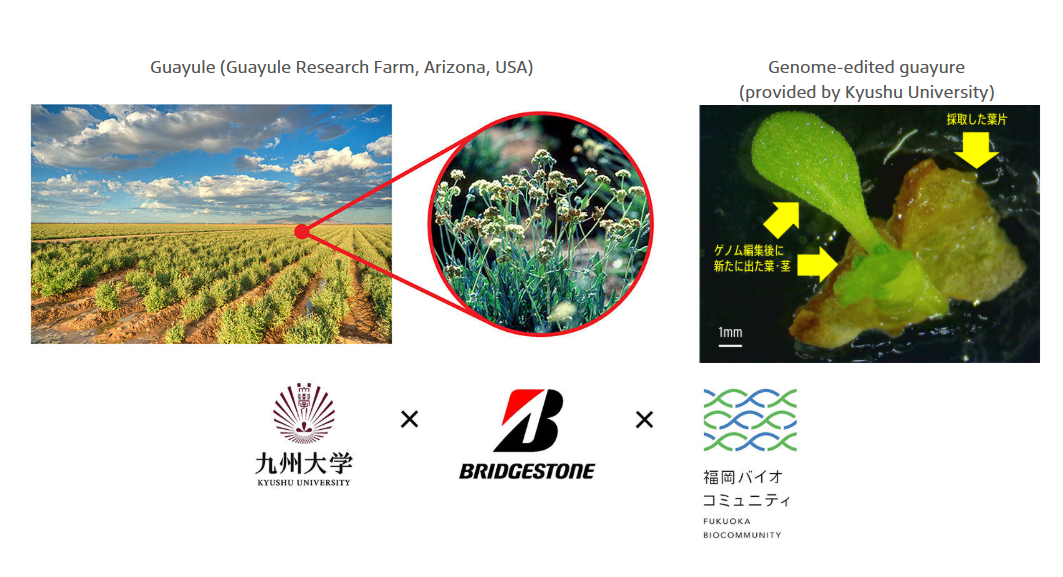
Researchers create genome-edited guayule specimens to support NR diversification
Tokyo – Bridgestone Corp. has created genome-edited guayule individuals for the first time, it said, developing a foundational technology that will contribute to improving the rubber yield of the desert shrub.
In a 27 Aug statement, the Japanese tire and rubber group said it has been conducting R&D with Kyushu University as part of a project implemented by the Fukuoka Bio Community, using genome-editing technology to improve guayule rubber productivity.
In the joint research, Bridgestone said, the first technical challenge was to regenerate a plant from genome-edited guayule cells.
This was overcome by combining Kyushu University’s plant genome-editing technology with Bridgestone’s knowledge and expertise in natural rubber.
This, it said, resulted in the successful creation of genome-edited guayule individuals.
Moving forward, Bridgestone will use the genome-editing technology to “search for and elucidate the functions of useful genes involved in improving guayule rubber productivity.”
Genome editing uses artificial enzymes to partially delete DNA strands that make up an organism’s genome.
Bridgestone went on to add that the process is ‘a non-GMO technology’ as it does not involve the introduction of foreign genes.
Guayule is a shrub native to the arid regions of the southwestern US and northern Mexico, with rubbery compounds contained in its tissues.
Bridgestone joined the Fukuoka Bio Community project in June 2024, taking on R&D efforts to develop a technology to improve guayule productivity.
The group said the research forms part of its efforts to promote technological innovation using biotechnology and expand the use of renewable resources.
The achievement is expected to accelerate Bridgestone’s research into improving guayule varieties, with the aim of diversifying natural rubber sources and commercialising guayule.
Bridgestone launched its research into guayule in 2012, and is currently operating a guayule research farm and research facility in Arizona, US.
The group is working towards practical application of guayule and its adoption in racing tires, but said improving rubber productivity per unit area remains a challenge.
This article is only available to subscribers - subscribe today
Subscribe for unlimited access. A subscription to European Rubber Journal includes:
Every issue of European Rubber Journal (6 issues) including Special Reports & Maps.
Unlimited access to ERJ articles online
Daily email newsletter – the latest news direct to your inbox