European export destinations, including Germany, France and Turkey, see year-on-year declines
Milan, Italy – Stronger demand from the US and China has helped offset weakening sales in core European markets for Italy’s rubber & plastics processing machinery sector in 2025, according to industry association Amaplast.
Citing a report by Amaplast study centre, the Italian association said the sector closed 2025 with production down 5% year-on-year at €4.4 billion.
Amaplast said the figures confirmed a general slowdown in the industry, with Germany as the key competitors also recording a significant decline in orders, sales and exports.
Exports, which account for three quarters of output, fell by 5.2% year-on-year to just over €3.4 billion, said Amaplast 24 March.
Sales to Germany fell for a second consecutive year, the report said, noting “broad losses” across the German plastics and rubber industry.
The German industry, Amaplast said, recorded a 4% year-on-year volume decline in polymer production and a 5% drop in revenues for machinery manufacturers.
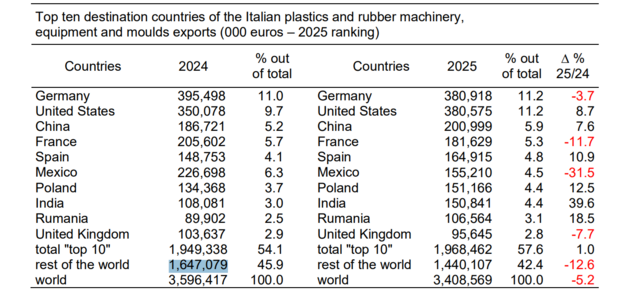
While sales to Germany fell 3.7% year-on-year to €380.9 million, the country remained the top export market for Italian polymer processing machinery, accounting for 11.2% of overall exports.
Exports to France also decline 11.7% year-on-year to €181 million, accounting for a 5.3% share of total exports.
By contrast, exports to the US rose by nearly 9% year-on-year to €380 million, while sales to China continued to increase “at a steady pace”.
In the US, Amaplast noted that the domestic machinery production meets “only a limited share of local demand,” therefore forcing processors to continue sourcing “advanced technology” from abroad.
Demand from India surged even faster, rising 39.6% year-on-year, supported by “the growing incentives provided by the ‘make in India’ programme.”
Turkey and Brazil, two other important countries that recently rejoined the group of top 10 destination markets produced “disappointing results”.
Sales to Turkey plunged by over 30% year-on-year, breaking a five-year robust growth trend.
In Brazil, sales decline 45% compared to the year before, which Amaplast partially linked to “the abnormally high peak in 2024.”
With an overall sales of €1.97 billion, the top 10 markets together accounted for 57.6% of exports in 2025, up from 54.1% a year earlier.
This represented a 1% year-on-year increase in sales value.
Exports to “the rest of the world” fell 12.6% year-on-year to €1.44 billion.
By region, Europe remained dominant, taking 52.3% of exports, followed by Asia/Oceania at 19.0% and North America at 17.1%.
Africa accounted for 6.2% and Central and South America 5.4%.
At the same time, imports of machinery into Italy surged nearly 24%, driven in part by Industry 4.0 and 5.0 incentives.
The trade surplus consequently narrowed from a record €2.65 billion in 2024 to €2.24 billion.
Across product segments, most machinery categories saw declines, including extruders, blow-moulding and flexography machines, as well as moulds.
Injection moulding machines were the only ones to “buck the trend,” with a modest increase in sales.
Despite the downturn, companies broadly held employment steady, with Amaplast members reporting a slight increase of 0.5%.
Looking ahead, the association remained cautious, saying “it has never been so difficult to venture forecasts.”
The association pointed to uncertainties caused by the introduction of tariffs by the Trump administration, the devaluation of the dollar against the euro and “the troubling war in the Middle East”, which it said has “triggered an energy crisis.”
The energy crisis, it noted, “has already begun to have a strong negative impact on the European plastics and rubber processing industry by increasing the costs of natural gas, petroleum, and raw materials and generating uncertainties about the availability of materials.”
The report warned of “a host of factors that threaten to compromise the propensity for investment in the domestic market”, particularly in Europe, which remains the main destination for Italian exports.