Rubber volumes lift Sri Trang Q4 revenue, but full-year loss widens
Thai group cites “volatility” and pricing pressure despite stable demand
Bangkok – Sri Trang Agro-Industry (STA) has reported broadly flat full-year revenue for 2025, as higher rubber volumes and a fourth-quarter rebound partially offset weaker prices and continued market “volatility.”
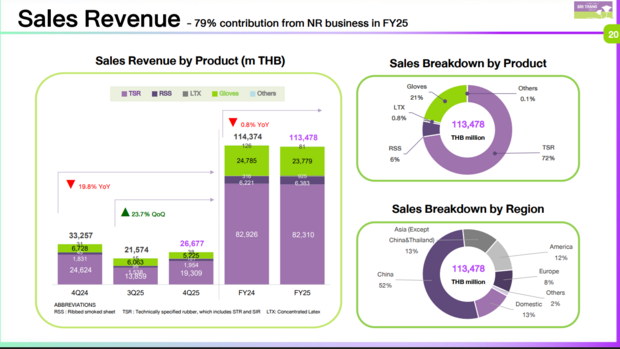
Revenue for the year edged down 0.8% year-on-year to THB113.48 billion (€3 billion), while the group posted a net loss of THB1.27 billion, compared to a profit of THB1.67 billion a year earlier.
Full-year earnings (EBITDA) almost halved to THB4,049 million, as volumes fell, particularly within the rubber gloves business, according to results released 20 Feb.
For the full year, the natural rubber (NR) segment generated THB89.62 billion in revenue, with sales volume of 1.42 million tonnes, “comparable to the previous year.”
The glove business posted a 4% year-on-year decline in sales to THB23.78 billion, with volumes down 3.8% year-on-year to 37.1 billion pieces.
The decline came despite relatively stable demand, with the company noting that the market was impacted by “heightened volatility.”
Furthermore, a 20% fall in global NR prices during the year, linked in part to US tariff measures, and broader economic uncertainty weighed on results.
In the fourth quarter, performance improved sequentially, with revenue rising 23.7% quarter-on-quarter to THB26.68 billion.
The performance, said STA, was supported by a 39.2% rebound in rubber volumes to 367,546 tonnes.
However, quarterly revenue was still down 19.8% year-on-year, reflecting lower selling prices.
Earnings remained under pressure, dropping 79.3% year-on-year to THB581.6 million in the fourth quarter, while net profit came in at THB325.7 million, down sharply from THB854.3 million a year earlier.
In the fourth quarter, glove sales were affected by flooding in southern Thailand, which disrupted some production, said the group, noting that its facilities are insured and compensation is expected in 2026.
By region, China remained the largest market, accounting for 52% of total revenue, followed by other Asian markets (13%), the domestic market (13%), the Americas (12%) and Europe (8%).
Looking ahead, STA said it expects market conditions to “move toward a more balanced condition” in 2026.
The group anticipates pressures from the futures market to ease and supply to remain constrained by declining plantation areas and weather risks.
The group added that prices on the SICOM exchange have shown “positive momentum” since the start of the year, adding that a narrowing price gap between NR and synthetic rubber could support demand.
This article is only available to subscribers - subscribe today
Subscribe for unlimited access. A subscription to European Rubber Journal includes:
- Every issue of European Rubber Journal (6 issues) including Special Reports & Maps.
- Unlimited access to ERJ articles online
- Daily email newsletter – the latest news direct to your inbox
- Access to the ERJ online archive