Pirelli-led partnership targets 'tire-to-tire' circularity
Tire maker joins forces with Synthos, Pyrum and BASF to transform ELTs into recycled feedstock for new tires
Milan, Italy – A consortium of leading tire & rubber industry players, headed by Pirelli, has launched a European initiative to advance tire circularity: transforming scrap and end-of-life tires (ELTs) into recycled materials for new-tire manufacture.
Pirelli, Pyrum, Synthos and BASF are jointly developing “an industrial ecosystem” designed to increase the use of recycled materials derived from ELTs, the companies announced 22 July.
The initiative will use waste tires collected across Germany, including from selected retail outlets, motorsport activities, as well as production scrap from Pirelli's Breuberg tire plant in Germany.
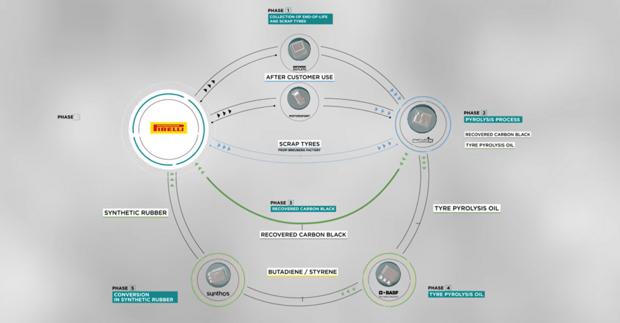
Tires will be processed through an industrial-chain designed to "maximise their inner value", converting them into secondary raw materials – including synthetic rubber – certified under the ISCC+ scheme.
The certification, said the partners, will ensure traceability throughout the value-chain and enable the recycled materials to be reintroduced into the manufacture of new Pirelli tires while maintaining "the highest standards of quality and performance."
Within the process, German recycler Pyrum will use pyrolysis technology to convert ELTs and scrap tires into two secondary raw materials: recovered carbon black (rCB) and tire pyrolysis oil (TPO).
The rCB is to be upgraded and reintroduced into Pirelli's European tire production, partially replacing virgin carbon black and the TPO supplied to BASF for use in the production of chemical intermediates, including butadiene and styrene.
Using a mass-balance approach, the recycled content will be attributed to BASF's ISCC+-certified products. The feedstock will then be used by Synthos to manufacture ISCC+-certified synthetic rubber.
The synthetic rubber will subsequently be supplied to Pirelli for use in new-tire production, completing what the partners describe as a "tire-to-tire circular value chain”.
"The project perfectly reflects that genuine product circularity cannot be achieved by a single company acting alone," the partners stated in the project announcement.
Instead, they believe circularity "requires creating industrial ecosystems involving players with complementary expertise", each contributing to different stages of the material transformation process.
Concluded the consortium, the initiative represents "the most comprehensive application of this approach to date", demonstrating how ELTs can become a valuable resource within a "structured and traceable industrial loop."
This article is only available to subscribers - subscribe today
Subscribe for unlimited access. A subscription to European Rubber Journal includes:
- Every issue of European Rubber Journal (6 issues) including Special Reports & Maps.
- Unlimited access to ERJ articles online
- Daily email newsletter – the latest news direct to your inbox
- Access to the ERJ online archive