
ERJ Brainteaser - May
29 May 2026
For superb answering throughout May, it's congratulations to: Kamila Staszewska, Amparo Botella, Bharat B Sharma, Andrew Know, new joint holders of the Brainiac of the Month title



Question 4: Larger letters
M > L / O > E / R > S / ? > ? /
Answer: The correct answer was E and S, more or less. Very well done to: Kamila Staszewska, R&D / quality lead, Abcon Industrial Products Ltd, Cootehill, Co. Cavan, Ireland; Amparo Botella, responsable de Compras y Calidad, Ismael Quesada SA, Elche, Alicante, Spain; Andrew Knox, Rubbond International, Ohé en Laak, The Netherlands; John Coleman, membership manager, Circol ELT, Dublin, Ireland; Bharat B Sharma, technical director TWC Group (Techno Waxchem & Rajsha Chemicals), Kolkata, India; John Bowen, BSc [Hons], CEng, MIMMM, consultant, Bromsgrove, UK; and everyone else who had a go.
SOLUTIONS
Kamila Staszewska
STAR ANSWER 1 – Great warm-up!
As this is not a Monday morning warm up but nearly midweek, I suppose my head was already in the game so I started connecting dots in more “material” related way:
more Microvoids -> less Lifespan
more Oxidation -> less Elasticity
more Roughness -> less Strength..
When I realised the letters in columns are actually neatly spelling MORE > LESS
(PS. Just to finish my chain-of-thought maybe can add more Elasticity > less Stiffness?)
Amparo Botella
I think the test letter will create the words More and Less so the reply will be E>S
M > L
The > E
R > S
E > S
Andrew Knox
Answer: E > S
The first letters here then spell "MORE" and the second letters of each pair spell "LESS". As in "More" is greater than "Less".
John Coleman
Probably easier to detect if we lay these out in rows:
M > L
O > E
R > S
? >?
A pattern then emerges where the final row of E > S gives us MORE > LESS.
Bharat B Sharma
STAR ANSWER – Sometimes more is more!
M > L / O > E / R > S / E > S /
Answer could be E S
It could be tricky – the way last few puzzles are being given.
I feel, we have 4 pair of alphabets M L O E R S ? ?
There appears to be two words made after combining first alphabets and second alphabets -
MORE LESS
If we see the first alphabets of each pair —
We get M O R ---
If we see the second alphabets of each pair
We get L E S ---
Both are four alphabets each – so the order can be seen as reversed in last two in the sequence (MORE LESS) which is seen starting the third combination.
Sequence
- Mis more than L
- Ois more than E
- R is less than S
- E is less than S
We have two first alphabets (M & O) of numerator more than the denominator alphabets (L &E)
And We have last two alphabets (R & E) of numerator less than the denominator alphabets (S & S)
Answer -- M > L / O > E / R > S / E > S /
John Bowen
I think this is all about the Morse code for each letter, spelling 'MORSE' vertically'
So, next would be 'S > I' [. . . > . .], followed by E [.] alone, as there is zero less than 1.
New teaser on Monday
Question 3: James Bond (revisited)
1 Bogota
2 London
3 Montevideo
4 ?
5 Podgorica
6 Stockholm
7 Tokyo
ANSWER: When we ran a similar question some years ago, our question-setters seemed to enjoy it more than the readers. Same this around with all but our top Brainiacs making the connection between agent 007 and the cities with two Os in their name. Stirred not shaken this time were: Kamila Staszewska, R&D / quality lead, Abcon Industrial Products Ltd, Cootehill, Co. Cavan, Ireland; Andrew Knox, Rubbond International, Ohé en Laak, The Netherlands; Amparo Botella, responsable de Compras y Calidad, Ismael Quesada SA, Elche, Alicante, Spain; Hans-Bernd Luechtefeld, consultant, Germany; John Coleman, membership manager, Circol ELT, Dublin, Ireland. Well done to our select group and everyone else who had a go.
SOLUTIONS
Most neatly explained by:
Kamila Staszewska
These are capitals with 0-0-7 in name in alphabetical order – the missing capital is OSLO
B0g0ta
L0nd0n
M0ntevide0
0sl0
P0dg0rica
St0ckh0lm
T0ky0
New teaser on Tuesday – due to yet another UK bank holiday!
Question 2: Cowboy conundrum
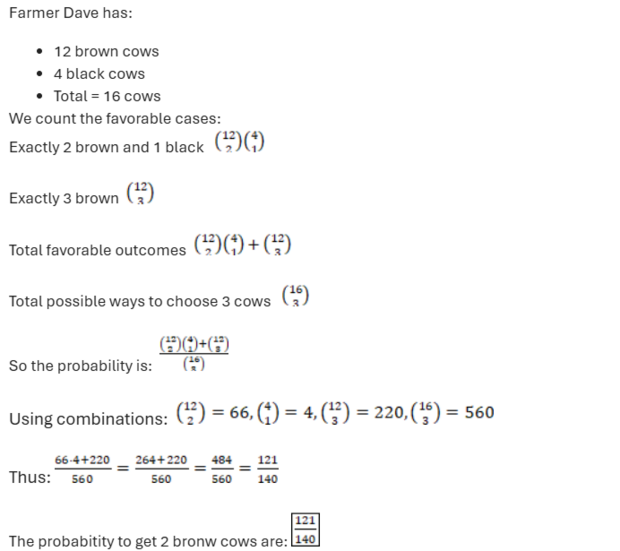
Farmer Dave has 12 brown cows and 4 black cows in a field. He selects three at random to bring to market. What is the probability that Dave chooses at least two brown cows?
Answer: This one proved tricky for many readers but not top Brainiacs: Amparo Botella, responsable de Compras y Calidad, Ismael Quesada SA, Elche, Alicante, Spain; Kamila Staszewska, R&D / quality lead, Abcon Industrial Products Ltd, Cootehill, Co. Cavan, Ireland; Bharat B Sharma, technical director TWC Group (Techno Waxchem & Rajsha Chemicals), Kolkata, India; Hans-Bernd Luechtefeld, consultant, Germany; Andrew Knox, Rubbond International, Ohé en Laak, The Netherlands. Well done to our select group and everyone else who had a go.
SOLUTIONS
Amparo Botella
(See solution above)
Kamila Staszewska
P of 2 brown + 1 black = (12*11)/(2*1) * 4/1=66*4=264
P of 3 brown = (12*11*10)/(3*2) =220
Favourable outcomes = 264+220=484
All possible outcomes = (16*15*14)/(3*2)=560
P=484/560 = 0.8643
Bharat B Sharma
The probability of Dave selecting 2 brown cows and one black cow is 121/140 (86.43).
Total Combinations – 16C3 == (16x15x14)/(3x2x1) = 560 Combinations.
At least 2 Brown cows – Either All 3 Brown cows or 2 Brown and 1 Black Cows.
All 3 Brown cows – 12C3 x 4C0== {(12x11x10)/(3x2x1)} x 1== 220
2 Brown cows and one Black cow = 12C2 x4C1 == {(12x11)/(2x1)} x 4 == 66x4 == 264
Total combinations of at-least 2 Brown cows = 220 +264 = 484
Total possible combinations = 560
Therefore total probability = 480 / 560
= 121/140 = 0.8643 (or 86.43%)
Andrew Knox
Answer: probability is approximately 0.8643
Possible outcomes are that the farmer randomly selects 3 brown cows, or 2 brown cows and 1 black cow in one of three possible sequences. So probability of at least 2 brown cows becomes 12/16 x 11/15 x 10/14 = 0.392857 plus 3 x (12 x 11 x 4)/ (16 x 15 x 14) = 0.471429, so in total a probability of ca. 0.8643. Of course, this calculation assumes that cows of a colour don't stick together.
Question 1: Commuter computer
If Gail leaves home and drives at a constant speed of 90km/hr, she will arrive at her office five minutes early. If the same journey is done travelling at 75km/hr, she will arrive six minutes late. How far is Gail’s home from her office?
Answer: That makes for quite a long commute, looking at the neat solutions (below) from: Andrew Knox, Rubbond International, Ohé en Laak, The Netherlands; Kamila Staszewska, R&D / quality lead, Abcon Industrial Products Ltd, Cootehill, Co. Cavan, Ireland; Dr Kate Burns, senior technologist and regulatory officer, Prisma Colour Ltd, Birch Vale, High Peak, Derbyshire, UK; Amparo Botella, responsable de Compras y Calidad, Ismael Quesada SA, Elche, Alicante, Spain. Well done to the select group and everyone else who had a go
SOLUTIONS
Andrew Knox
Answer: 82.5 km
First important to get all the units the same (i.e. km and minutes):
90km/hr = 1.5 km/ min, 75 km/hr = 1.25 km/min
Distance travelled = speed x time
Given (t-5)x1.5 = (t+6)x1.25, then t = 60 min
So, distance to work is (55x1.5) km or (66x1.25) km, both being equal 82.5 km.
Kamila Staszewska
STAR ANSWER – Nice fun fact!
Home to office = 90(t-5)=75(t+6)
90t-450=75t+450
15t=900 à t=60min
So, it takes 60min for a ‘perfect’ journey.
90kmph*55/60h=82.5km
Fun fact: the perfect speed for Gail is actually the arithmetic mean of her quick and slow travel!
Dr Kate Burns
The distance travelled is equal, and the difference in time is 11 minutes, so if t is the time the journey takes at 90 kph:
90t = 75(t+11) = 75t + 825
15t = 825
t= 55 minutes
Travelling at 90 kph for 55 minutes gives a distance of 82.5 km.
Amparo Botella
We will call the distance d and the time t:
At 90 km/h: she arrives 5 minutes early → actual time is
At 75 km/h: she arrives 6 minutes late → actual time is
This means:
d/90=t-(5/60)
d/75=T+(6/60)
Subtract the first equation from the second:
d/75-d/90=11/60
6d-5d/450 = 11/60
D/450 = 11/60
D=11/60*450=82,499
The reply is that Gail lives 82.5 km from her office
